
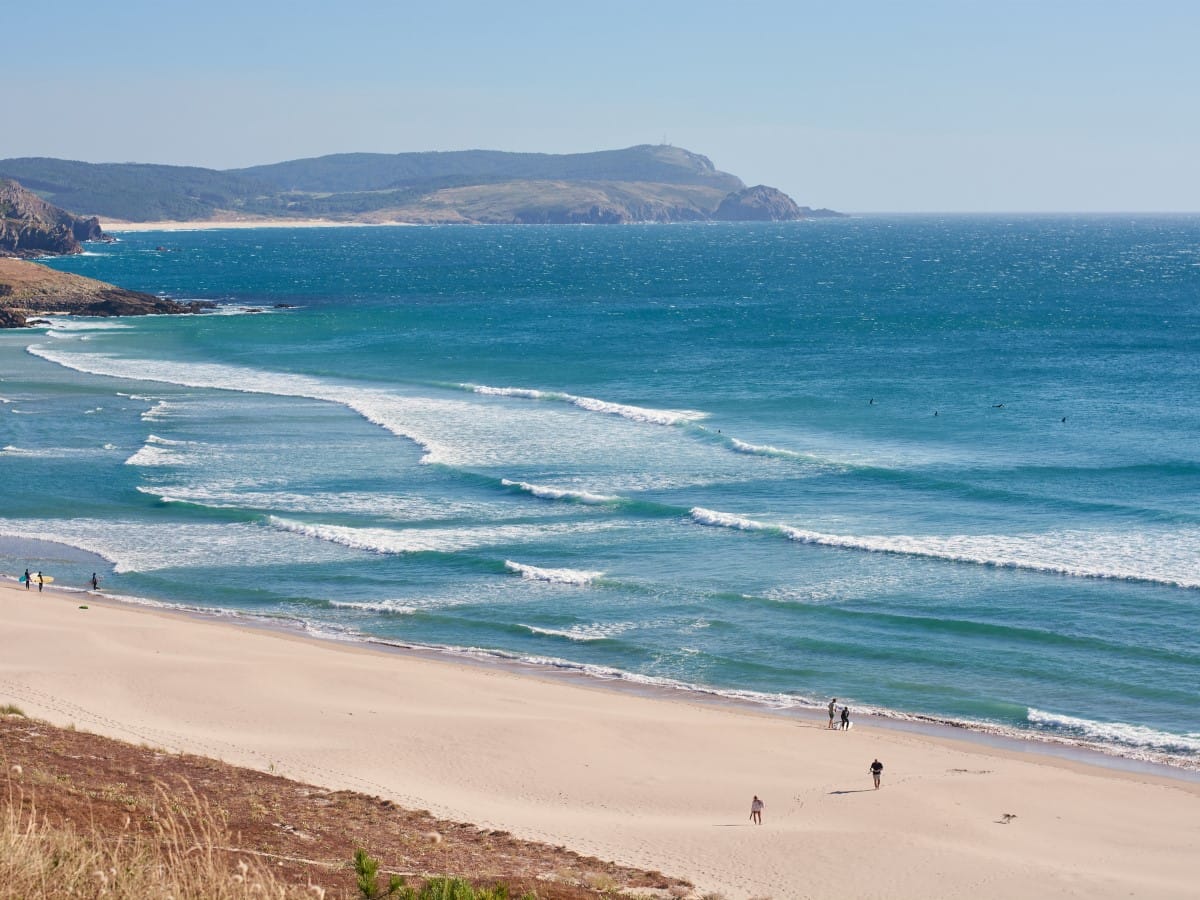
Galicia Surfing Guide – Best Beaches / Surf Towns / Seasons

It’s the consistency of Galicia surfing that makes it so awesome, along with thinned crowds and remote beaches. Downsides include blown out days and hard-to-access beaches, but catch it right and it’s wonderful. As wonderful as Europe gets.
An introduction to Galicia surfing
Galicia isn’t really like anywhere else in Spain. That’s true of the geography – lush and green. It’s true of the language – it’s more like Celtic Welsh in these parts (:/). And, it’s true of the surfing…
This is one of the few parts of the country that faces truly west out towards the Atlantic. It’s got a coastline on the Bay of Biscay, and more shore running north from the Portuguese border. If you’re thinking that means loads of swell-exposed coastline, you’d be thinking right.
In fact, the greatest thing about Galicia is the sheer range of bays and beaches. They move north and then go west in a really higgledy-piggledy manner. It’s rare to find two in a row that face the same angle, and that means you can go searching for the spots that are picking up dominant swells and nice offshores, provided you know where to look!
Sadly, the downside of Galicia’s main spots is that they are predominantly exposed beach breaks. That’s great news in spring, autumn and summer, when Atlantic swells are tamer. It’s not so good when direct W and NW swells come in during wintertime.
There’s little reef to add shape to the sets and they’ll often be closeouts and blowouts. That said, crowds are nothing here, even compared to the relatively sparse beaches of northern Portugal, and remember what we said about chasing those offshores?
It’s territory for the adventure surfer who love to wake, drive, and paddle out early, totally alone.
We might use affiliate links in this post. Basically, you click em’ and we get a little something from your booking or purchase. They help us keep offering more and more in-depth surf guides to awesome places all around the globe. So, thanks for that!
This is just one part of our full guide to surfing in Spain
Galicia surfing at a glance
The good:
- Really wide swell window – AKA all year
- Beaches that face all directions
- This is a really beautiful part of Spain
The bad:
- The spots don’t hold much swell
- You’ll need a car
- Cold water
What’s in this guide to Galicia surfing?
Where is Galicia?
Galicia is the far northwestern portion of Spain. It’s a whole province, with one foot in the Atlantic Ocean and the other in the Bay of Biscay.
To the south, you’ll cross straight over into Portugal, where there’s plenty more surfing – of course!
To the east, you’ll find yourself in the region of Asturias, another of the best surf regions in Spain.
The main cities in Galicia are Vigo – an old port town that’s famed for its fish – and Santiago de Compestela – best known as the western end of the camino pilgrimage walk.
How to get to Galicia?
Flying to Galicia
Santiago de Compostela has the main airport in Galicia. Direct links and some low-cost links to other major European hubs are available. The airport’s official name is Lavacolla. The trip to the nearest surf beach on the west coast is a little under an hour. There are also links to La Coruña Airport on low-cost airlines and the even smaller Vigo–Peinador Airport, both of which will put you closer to the coast and surf spots.
The other option is to fly to Porto (in Portugal). A lot of surfers do that since it’s a great way to surf the lush Costa Verde in northern Portugal before crossing into Galicia. It’s usually okay to drive a rental car from Portugal to Spain but always check that with your hire company beforehand as there might be extra surcharges.
Try using Kiwi to search flights – they have a unique algo that links together all airlines to get the best deal, not just the ones that use codeshares. It can turn up some great bargains.
Trains to Galicia
Trains into Galicia have improved a lot in the last 20 years. You can now do high-speed links from Madrid, which means good connections to cities all over Spain. There’s also a line that links up much of northern Spain directly, which is good if you want to do a rail-based surf trip through the most surf-rich part of the country.
There are even now high-speed links to A Coruña and Vigo from Porto and Lisbon.
We tend to use RailEurope for our train bookings here.
Driving to Galicia
It’s not hard to drive into Galicia from Spain or Portugal, or from the rest of Europe provided you have the time. The A55 and AP-9 roads join it to Portugal over the border, where it’s about an hour to Porto. The E-70 links the coast of Spain in the north, which will be your route in from the surf beaches of Asturias and Cantabria.
The A52 goes down to Valladolid and then Madrid, which is about five hours away from A Coruna (one of the hubs of the Galician surf coast). Driving is a really great option because Galicia is best surfed with your own wheels and your own board (more on that below).
Should I hire a car to surf in Galicia?
YES! If you don’t have a ride then you’ll probably need one to really enjoy all that Galicia has to offer.
We always try to be honest when a surf region doesn’t require you to rent. They do exist in Spain – Zarautz, San Sebastian – so you do have options if renting is a no no.
Galicia’s strenghts are how undeveloped it is and the sheer variety of beache and bays pointing different ways. Being ready to jump in the car/van and drive to the right location will put your surf trip on a whole other level.
Either drive yourself up in your own ride if that’s an option or rent on arrival. The good news is that Spain tends to have some of the cheapest car hires in Europe. We use RentalCars.com for all of ours, since they offer nice cancellation policies up to 48 hours before travel lots of the time.
Surf spots in Galicia
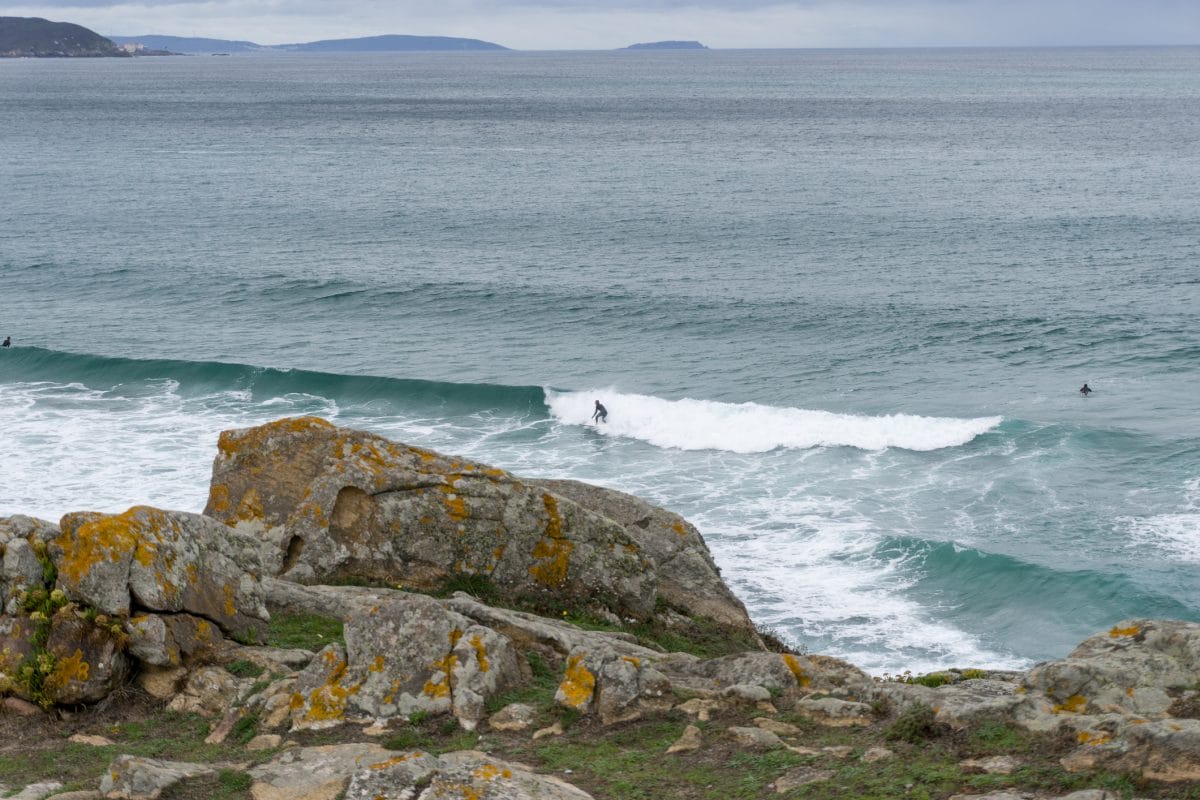 iStock.com / Angelica Pardo
Galicia has lots of surf spots.
You can roughly divide them into the ones on the west coast and the ones on the north coast.
The former tend to be bigger and generally better in the summer months, because they magnetize that cross-Atlantic swell and offer up any little thing going.
The north beaches are more protected but offer a similar consistency to the neighbouring region of Asturias, which is okay but not great. That said, there are some there that bend westwards to act more like a west coast break – Pantin is a case in point.
Surf spots in northern Galicia
Reinante (and Rinlo)
Reinante surf is close to the westernmost of the spots in the neighboring region of Asturias.
It’s not west-facing, so less consistent than other options on this list. Still, when it gets a northerly or a big wrap-around swell, the beach here kicks up lovely lefts.
They can be barrely or steep with a crumbly top. Gets busy with sunbathers in June, July and August.
There’s a MUCH gnarlier spot called Rinlo just down the coast that’s a bit of a mythic wave for the locals here. Very fickle, it only works with strong NW swells and S winds, when it sucks off a reef. You’ll have to ask around for access and it’s really very advanced surfers only if you wanna go there.
San Cosme
San Cosme is one of the more consistent options on the north coast. It’s sheltered from the west by the bulge of northern Galicia, so will need some good strong W or NW swells to get pumping.
It’s a beach break with a few separate peaks. Works well on a nice chest-high swell when it’s rippable on a shortboard but also great for longboarders who like to trim.
The main spots are A-frame breaks right in the middle of the beach. Lefts and rigths are just as good as each other so come with your goofy friend to keep them happy.
Foz
Don’t rely on the rivermouth break at Foz. It’s not a consistent wave and really fickle, because it needs pretty punchy W wrap-around swells to get going. Perfect at 6-8 foot and then it’s a hollow and very fast tube off the estuary that goes left.
The real joy here is the greater Foz region, specifically the run of coast to the east of the town and the river estuary. That’s a succession of little reefs and point breaks that offers about 5 named spots that are each pretty high quality and good for varying levels – a prime example of why Galicia is a true surf roadtrip jewel!
Cruise the coast road and look for the wave that suits.
Where to stay? Malates Slow Boutique Hotel is a fine base on the edge of the river estuary. It’s just off the N-642 road, which will take you east and right to the surf spots. You’ll also get super stylish rooms and a gorgeous garden with a pool.
Looking to surf in Foz? Be sure to check out our full guide to Foz and what it has to offer!
Playa de Esteiro
Playa de Esteiro is really the first beach that faces westwards as you swing around the Galician coast on your way out of Asturias.
That gives it the benefit of good exposure to the Atlantic and all-round more reliable surf. Try to come when the mid to low, becuase shallower water brings the best sandbanks into play.
They’ll form nice long lefts on mid swell sizes, which are regular throughout the spring and summer thanks to that decent westerly and northerly exposure. There’s also a reliable A-frame that works just infront of the rivermouth.
The setting is lovely, with evergreen forests rolling across the nearby dunes. Not often terribly busy. Head to the Esteiro Surf Café for post-dawnie coffees and breakfast.
Esteiro Surfing offer rentals and lessons from thier base on the beachfront.
Where to stay? Esteiro Surf Lodge is the place to go for. No doubt. It’s out top-pick hotel for surfers in the whole region!
La Machacona
La Machacona has been hailed as the single best wave in Galicia. Most people doing the hailing are advanced surfers who pine after those heavy, winter barrels.
This is is a very challenging right hander that works best on a dropping mid-to-low tide. Breaks fast over a shallow rock shelf that’s taken its fair share of flesh over the years.
The main drawback is that it’s not reliable at all. Needs big N elements to the swell, which means it’s usually Nov-March only. Look for acces in the bays south of Burela.
Praia Sarridal
Praia Sarridal is a perfectly arched bay between two high mountains that also faces north-west at the end of its own peninsula.
A few dashes of offshore reefs can help add some nice shape to the waves at either end of the beach but the mainstay is the punchy beach break that rolls into the middle.
The whole spot is at its best when in the 5-7 foot range. It won’t hold more than that but it reminds us a little of Arrifana when working – AKA prone to dumping but also fun when there’s the right angle to give some rippable shoulders.
Spring and Autumn are best because NW swells are killer in midwinter. Beware of rocks and rips.
Villarrube
Mostly, Villarrube is waaay too protected by the la Cabra headland to get any swell. There is a tiny, teeny window that can push some perfectly angled NW swell inside the bay.
It will only ever happen with the biggest of winter low-pressure storms. When it does there are two waves here: A low-tide point off the eastern rocks but that requires a long walk as the tide difference is a biggie, and a pushy little beach break that’s as cruisy as they come.
Pantin
Unquestionably the most famous of all the Galicia surfing beaches is Pantin.
It’s got a near-perfect NW orientation that means virtually any spring, autumn and winter swell runs straight into the bay. They’ll pick up power as they’re funneled into the middle of the bay, so 5-6 foot is often enough to offer barrels at some of the peaks.
The wave quality is generally pretty fantastic. A-frame peaks offer right and left rides, with the bulk of the line up clustering near the head at the north end, where you’ll get long rights and short, fast lefts.
Gets busy but is actually pretty chilled, especially for Spain where localism is quite rife.
Where to stay? Apartamentos Las Olas By Pantin – you can’t get closer to Pantin beach than this super-stylish aparthotel. It’s modern and comfy and a walk from the best peaks.
Check out our complete guide to surfing in Pantin right here
Valdoviño
Valdoviño is an interesting one. Rarely surfed but super reliable, it’s got some of the best consistency on the north Galician coastline.
The issue is the rips, which can be a nightmare at the NE end of the bay. At best, they’ll make it shifty as hell, so you’ll need to paddle around all over the place. At worst, they’ll drag you out into the Atlantic for a one-way ticket to Iceland if you catch our very strong drift.
The best way to dodge them is to head SW and tuck into the shadow of the headland. If it’s 10 foot plus on the exposed part of the beach then it can be a neat, clean 4-6 foot there with extra shelter from W winds.
Where to stay? Siete Playas Surf House has five bedrooms and enough space for a group of 10. It’s a classic Galician surf house with lots of authentic style.
San Jorge (sometimes called San Xorxe)
San Xorxe beach is surely one of the prettiest in all of northern Galicia – and that’s really saying something! It’s backed by wooded hills and runs for about 1.5 miles in all. A true wild, north Spanish beachfront.
The best surf is at the northern end of the bay. There, the water quality is some of the best around, because there are no rivermouths to interfere with the N-S currents.
It’s at that northern end that you get the nbest reliability in the form of longish lefts that peel off the headland and a series of punchy A-frames that are usually quite fat and workable.
As you go south down the bay the waves will tend to mellow, with overheads turning to chest high swells that are better for beginners and improversent.
Where to stay? Glamping Atlántico has belltents in the forests just behind the bay.
Ponzos
Playa de Ponzos is just north of Ferrol. It’s one of the harder-to-find spots but that’s good since the crowd factor is very low because of it. Drive north as you go west from Ferrol center and you’ll find a car park just above the bay. The walk down is about 10 mins from there.
The waves are punchy, peaky beach breaks for the whole way along, but the N orientation means the bay picks up LOADS of swell in fall and winter months. That translates into heavy barrels at some peaks, with hollow sections that can resemble mini Hossegor pits. And they’re often empty.
Definitely worth getting eyes on if it’s winter and there’s NW swell + a S wind.
Doniños
The 1.5-mile run of sand at Doniños is a favourite with the surfers of Ferrol. That means it’s quite busy, but there’s also room to spread out.
Before a run of wild dunes and a rugged headland, the beach offers multiple peaks. They’re quite reliable and form as wedgy A-frames with better lefts more common that quality rights.
Surf it at low or mid tide on the push to get the best rides.
Where to stay? Doniños Nature is one of the best surf hotels in the whole region. A series of Scandi-styled beach cabanas done out in plywood and hemp, they’ve got striking views of the beach and are PERFECT for couples.
Sabon
Ultra-reliable Sabon beach is, sadly, almost always too polluted to surf. That’s super annoying because it’s actually one of the most reliable and consistent spots on the coast here, plus the waves are real nice.
There’s talk of local government cleaning it up, and if that happens we’d be down here way more often on the lovely, longish lefts that come off the rocks to the south side of the bay.
Praia de Razo
Long enough to handle all the crowds that nearby A Coruna – the major regional town that’s some 45 minutes’ drive to the east – can throw at it, Praia de Razo is a great place to check out classic north Galician swells.
At its best, it’s a whole run of fast and rippable peaks, with peeling lefts and rights that can carry you 100-150m. In fact, there are about 4-5 named sections to the beach, including some pretty special reef breaks that are for more advanced surfers.
Some days turn crumbly and we don’t really know why – we rocked up with 3-5 foot with an offshore and it was just underwhelming. Other days it will turn on the goods when you least expect it. One thing will definitely ruin Praia de Razo, though: A N wind.
Where to stay? Espazo Nature is a special place. Wood-built cabanas and glamping pods with serious style, all looking over the eastern end of Razo beach.
We’ve got a full guide to surfing in Playa Razo right here
Surf spots in western Galicia
Praia de Soesto
Praia de Soesto is the beach on the ocean-facing side of Laxe town. It’s spectacular. Like, jaw-droppingly beautiful. White sand, turquoise sea.
There are nice long, trimmable rights that work at its north end and faster lefts to the south that are more suited to shortboarders.
Often gets blown out but remains consistent throughout the summer. Not many crowds and good for all levels (depending on swell size ofc).
Where to stay? Cabanas Narea – very cool eco shacks on Laxe beach, close to the cafes of little Laxe village. Only 5 mins’ driving from Soesto surf spots.
Nemiña
There are peaks all up and down this remote beach, but it’s really the left that runs off the Lires River that you’ll come for.
It gets working on any SW-NW swell direction and holds nicely up to 8 foot. Winds from the west can ruin it but look for a NE direction and you’ll nail a good day as the lines are groomed up into rippable walls that go for like 100 meters or more.
You also might be the only person out there!
Praia Carnota
Carnota is the Galician beach that really shows its teeth when the swells get going in the autumn. Set below the craggy and downright stunning Cabo Fisterra peninsular, it’s a seriously remote bay with a head-on collision with westerly swells.
Expect strong and powerful swells that wedge up to offer fast rides into a shoulder that’s sometimes rippable and very dumpy. Better for pros, intermediates okay. Rips are an issue and onshore winds are hell.
Praia de Lariño
Praia de Lariño is a beautiful stretch of SW-facing shoreline that sits below a little lighthouse near the village of A Gándara. It’s not great surf-wise becuase it can’t really hold anything over 5 foot, which means it won’t work in the winter storm season at all.
It’s a good beginner-all level wave in the summer months if you get a E offshore and something in the 3-5 range. And the beach is really, really pretty.
Where to stay? Hotel Faro Lariño is housed in an old lighthouse at the north end of the bay. Super highly rated, walkable to waves, and quirky sum it up.
Louro
The slight SW orientation of Louro means that it’s a tad sheltered from that NW winter oncoming and gets good southerly swells on the rare occasional they go. That all adds to the consistency and means ridebale days are pretty common.
You will have to make a hefty drive to reach the spot, because it’s out on its own headland about two thirds of the way from A Coruna to Vigo – the better option is to book one of the coast hotels in the area, which are lovely, and stay a few days for the surf.
Waves are nice at chest or head height but can close out at the center of the bay. A-frames for the most part and good for all levels when it’s under 5 foot. Good for the summer, too.
Furnas
Hidden little Furnas is a gem of a spot with powerful beach breaks that hit a really nice sweet spot an hour or so either side of low tide.
They’re sucky and there are strong rips, but you’ll often be surfing alone in the remote spot. Also known as Rio Sera, it’s a great option for anyone on a Galicia romp with their own van and boards.
Playa de la Lanzada
Just outside of the surf town of Sanxenxo is the ever-popular beach break at Playa de la Lanzada. We’d say it’s arguably the best beginner spot on the Galicia scene.
Works on all tides to give lots of mushy breaks towards the center of the bay. Watch out for the fast and challenging left-hand reef point that’s there, though. It’s a cracker but is a localism nightmare for some reason, even though there’s a good vibe at pretty much every other spot along the beach.
Lanzada does need some size to work properly. We’re talking W-NW swells of at least 4 foot and even then it will be mellow AF.
To surf here, stay in Sanxenxo. It’s a very cool summer resort that they say is a fav of the Spanish prime minister. True or no, it’s got good vibes and is the center of a great run of surf coast where Lanzada isn’t the only option by a long stretch!
Montalvo Beach
Montalvo Beach is only a couple of minutres from Sanxenxo. It’s not got the all-level breaks that Lazada can offer but does come up trumps if you’re hunting hollow shorebreak barrels in the winter. They only work on bigger storms but are mini Supertubos-like bombs for the more advanced surfer. Some localism.
Vigo
The region around Vigo has its pros and cons. Close to the Portuguese border, it’s got fantastic westerly exposure – like like the beaches on the Costa Verde in PT. It’s also one of the less popular parts of Galicia, with emptier lineups for the most part.
There’s a lot of industrial development in these parts, with huge port areas dominatining the area around the city itself, with all the ineveitable ugliness and pollution that goes with it.
We still like it as a base for surfing, espeically since you can link up with the beaches in north Portugal to do a special road trip across borders. The key is to be willing to drive south or north to escape the sprawl of the port.
Our hunch is that south is the better way to go – there are like 5 good spots between here and Patos and they’re quicker to reach from Vigo center than the spots around Sanxenxo.
We have a complete guide to surfing in Vigo right here
Patos
A lovely beach framed by Galicia’s green mountains and the islands just off the coast, Patos offers a duo of breaks.
The first is a pretty mellow beach break which is a fantastic for beginners in the summer and very nice for intermediates on the turn in the spring, autumn and winter. It’s sand bottomed and goes both left and right but is prone to a closeout on high days.
The other part of the beach has a rock reef underfoot but balances that risk with some nice, sometimes hollow peelers that are fast.
The proximity of Vigo means it’s often quite busy here, espeically since it’s the best spot in the whole region and the first that’s truly pretty after leaving behind the Vigo sprawl. Still, it’s a good base with good waves.
Where to stay? Patos Beach II – Cies is a three-bed, self-catering chalet with a fine balcony overlooking Patos’ north beach.
We have a complete guide to surfing in Patos right here
Best hotels (for surfers) in Galicia
The way we see it, you have a few options here…
1) Choose a hotel that’s really close to a beach, base yourself there, and be content surfing that break each day. 2) Book multiple hotels throughout Galicia and surf your way north and south. We really like the second option because there’s just so much to get through here, plus different beaches work better on different swells.
Anyway, short of plotting complete road trips through Galicia, here are some of our all-time fav surf stays in the region…
Esteiro Surf Lodge
You cannot beat the Esteiro Surf Lodge if you’re plotting a family or friends surf outing to Galicia. It’s right by the sands – like a walk to the breaks!
You can surf everyday and enjoy total seclusion out on the lovely north-west coast.
The pad is a traditional Galician casita, with whitewashed walls, a beach-view terrace, and a bright and breezy interior with a full kitchen. It’s awesome.
Espazo Nature
Espazo Nature is your ticket to the multiple, all-level breaks of Razo Beach, one of the most consistent spots in the region.
The hotel is more than just a hotel. It’s a real thing to behold, with chich Scandi-inspired design helping it to meld almost seamlessly with the dunes it sits on.
You can pick from cabins with gorgeous views and even luxury glamping tents. Walkable to the waves, but a car will help.
Area Surf House
Area Surf House has budget dorm rooms and doubles. It’s comfy, the folk who run it are super welcoming, and there are nice facilities and extras – think a games room and a long table for when you need to get some work done.
The location is prime for solo surfers – right there on the Muros headland with three or four fantastic west-facing beaches on the doorstep.
Surf camps in Galicia
The general rule is that the further east along the Spanish north coast you go, the more surf camps you’ll get. That’s evidenced by the growing number on offer near San Seb and throughout Cantabria. But there are some on offer in Galicia, including one that’s got access to the fantastically consistent beaches of the west coast for those summer surf getaways…
- Grip Surf House (7-Day Surf Camp) – Grip Surf House currently offer what we’d consider to be the very best option in Galicia. It’s a week-long outing to the epic beaches of the Corrubedo Peninsula near A Coruna. You get 10 hours of lessons, surf-skate sessions, loads of free surf time, and a group BBQ included in the price, which is a modest $500-ish per person!
- Camino Surf (various packages) – If you’re more tempted by the bigger surf on the north shores of Galicia, these guys are a good option.
When to surf in Galicia?
Galicia experiences similar seasons to northern Portugal, but also takes the colder waters of the Bay of Biscay. That said, having two coastlines here counts for plenty. Swell windows are opening to include NW and SW and everything in between. It’s only really the summer that can be small. Sadly, the chilly movement of water from up in the North Atlantic means a 4/3 is usually required in these parts, no matter the season.
Summer (June-Aug)
Wear: 4/3
Summer is the tamest season on the Galician waves. The NW swell channel all but shuts down when the Gulf Stream kicks in with warmer weather. You get some nice N-S currents that can bring occasional wrap-arounds in the bays of western Galicia, but they’re never overhead and wild. For the most part, it’s sporadic surf days and plenty for total beginners. Also, great weather!
Autumn (Sept-Nov)
Wear: 4/3
Autumn is a fantastic time to plan your Galicia surfing trip. The waves pick up and groundswell days really increase in frequency. We noticed a distinct upping in the period times, so there’s more punch to those western beach breaks, and more power to get the northern coast firing. Crowds also drop off considerably, and you can still catch the tail end of those warm-season NE offshores.
Winter (Dec-March)
Wear: 4/3 or 5/4 – booties and gloves too
Prepare to be crunched in the winter. The most exposed breaks, like Praia Carnota are pretty mental at this time of year. With NW swells churning up the Atlantic carried over by the Canarian Channel, you can set the overheads and closeouts like clockwork. It’s still great for Galicia surfing trips, but we’d recommend paying closer attention to more sheltered spots – like Louro in the west, for example, and San Cosme in the north.
Spring (April-May)
Wear: 4/3 and maybe a hood and booties towards the start of the season
The lighter, brighter days of spring on the Galician surf beaches means slightly mellower conditions. Thanks to the wide swell window of over 180 degrees, there’s plenty to pick up in the channels to the north and across the Atlantic more directly. The west is working, the north is working; the quality is sporadic but the crowds are small. We’d say April is for intermediates and up, but late May is fine for all levels.
Surf shops in Galicia
Galicia surfing is still very much off-the-beaten-path stuff. That’s why you don’t find as many surf stores here as you do in neighbouring Asturias or down in Porto region of Portugal over the border. The biggest crews are the local ones and they typically use local shapers more than most places in Europe.
Our advice? If you’re not looking to get something special made and spend a packet of euros, bring your own gear.
- Spot Surf Shop – Look for Spot Surf Shop in the de facto capital of Galicia surfing – Ferrol. It’s a fantastic little local outlet with stock of MSC boards, Billabong wetsuits and all sorts of surf fashion.
- Core Surfing – A super-cool shop a little inland from the coast, Core Surfing is a boutique shop with its own lineup of shaped boards. There’s also some cool threads on offer from major brands like Carhart, and a range of footwear. It’s a new place so expect swish things.
What to do (when you’re not surfing) in Galicia?
Galicia is gorgeous. However, it remains one of the lesser-known regions of Spain. With UNESCO pilgrimage sites with thousands of years of history and grand coastlines up its sleeve, we really can’t think why…
Praia das Catedrais
Praia das Catedrais is arguably one of the most breathtaking and dramatic beaches in the world. Carved from rough rocks, it drops into the lashing Atlantic with a series of huge stone arches. They’re amazing to look at and the reason for the name: The Beach of the Cathedrals.
Santiago de Compostela
Santiago de Compostela is legendary throughout the world as the end of the Comino pilgrimage route. It’s been an important religious site since the Middle Ages and now has a UNESCO tag for its great cathedral and stunning Old Town. We really don’t think you can miss this one on any trip to Galicia! Guided tours of the whole downtown are a great way to get stuck into the history.
Wine!
If you like wine and you like surf, Galicia WILL NOT dissapoint. This region is home to my personal favorite white wine in the whole damn world: Albarino. Do yourself a favor and book onto a guided tour to visit the wineries. You’ll want to have a drink, obviously! This day-tour of the Rías Baixas is one of best out there. It includes loads of local history and art, plus a proper Albarino wine cellar.
We might use affiliate links in this post. Basically, you click em’ and we get a little something from your booking or purchase. They help us keep offering more and more in-depth surf guides to awesome places all around the globe. So, thanks for that!
