
Witch’s Rock, Costa Rica – Surfing the legend in Santa Rosa

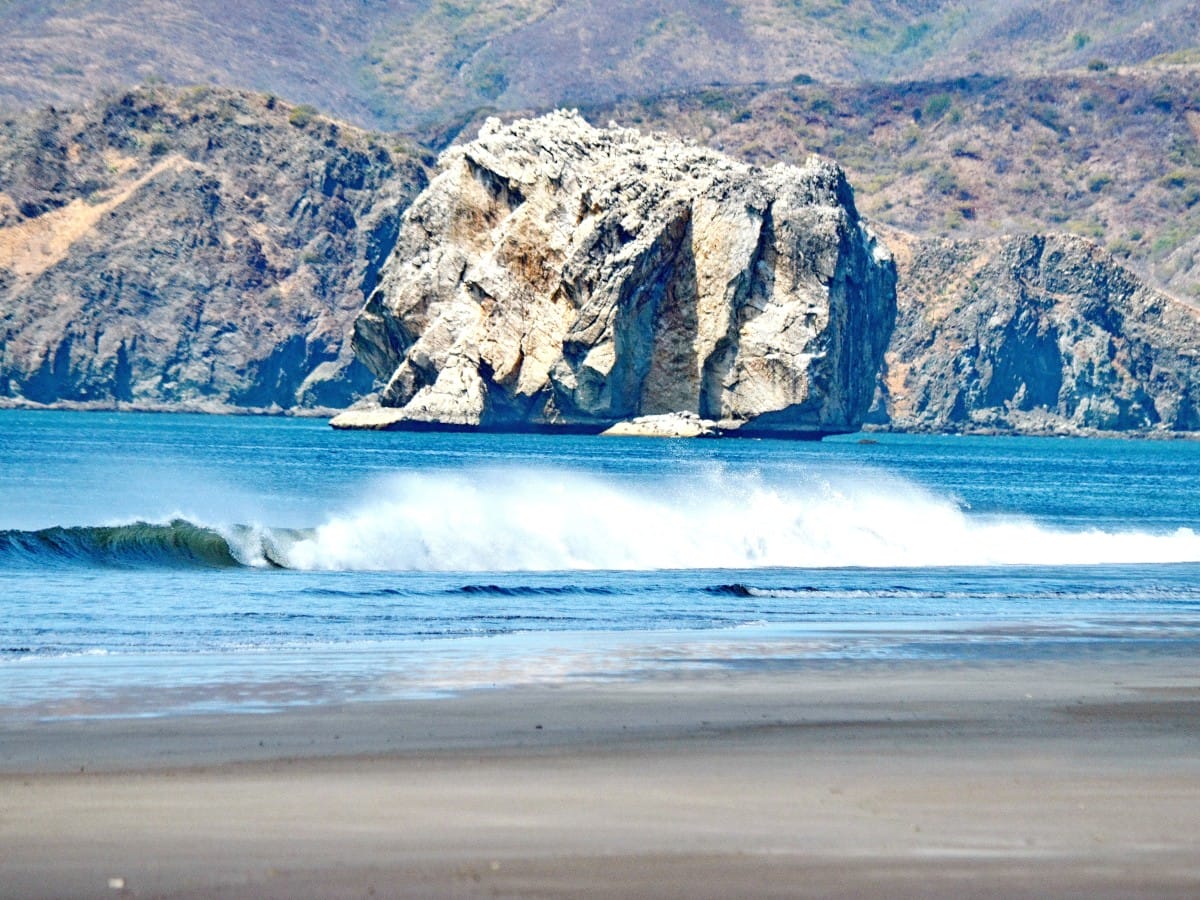
Witch’s Rock — Roca Bruja — is one of the undisputed legends of the Costa Rica surf scene. It’s one of the waves that helped to put this country on the map.
Imagine this: A wild outpost on the northern Pacific region, where offshore winds groom powerful beach break peaks all dry season, and an iconic stone monolith towers out of the sea like something out of Jurassic Park.
It’s remote, raw, and arguably the most mythical wave in the country, but that sometimes strikes us as strange since it’s far from the best wave in Costa Rica. Swells need to be just right, and so do winds. Otherwise you can see closeouts all day long.
It’s generally a nice A-frame when it works, with the potential – depending on size – to work for multiple levels.
>>Check out our full guide to surfing in Costa Rica for more information on the specific surf towns in this amazing country
How to get to Witch’s Rock?
This isn’t a drive-up, paddle-out kind of spot. Witch’s Rock sits inside Santa Rosa National Park, one of Costa Rica’s oldest protected areas, about an hour northwest of Tamarindo. The break is only accessible by:
- Boat – The most common option. Boats leave from Playas del Coco, Tamarindo, and Playa Flamingo. The ride takes 1–2 hours depending on conditions. Many surfers book with charter operators who include lunch, shade, and multiple surf sessions (often combined with nearby Ollie’s Point).
- 4×4 Mission – Possible, but not easy. You’ll need permission to enter the national park and a high-clearance vehicle to tackle rough roads and river crossings, especially in the wet season. The final leg is a walk through jungle and mangroves to reach the beach.
Because of its isolation, Witch’s Rock stays uncrowded compared to more accessible surf towns. But don’t expect to be alone — charter boats often bring in small groups early in the morning when winds are best.
Surfing Witch’s Rock
Witch’s is a sand-bottom beach break with multiple peaks that fire with power and precision when the conditions line up.
The backdrop is the legendary volcanic rock itself — a 40-meter-high outcrop just offshore that gives the spot its name.
The wave
- Type: Fast, hollow beach break
- Bottom: Sand
- Skill: Intermediate to advanced
- Best swell: SW swells (May–Oct), especially long-period ones
- Wind: Offshore trades blow nearly every morning in the dry season (Nov–Apr)
- Tide: Mid to high tide is best; low tide can be too shallow and dumpy
Witch’s Rock can hold up to double overhead on a solid swell but still offers playful, chest-high waves on smaller days. There are multiple peaks to choose from, with the main one closest to the rock offering steep takeoffs and rippable walls.
It’s a spot where good surfers thrive — the wave barrels on the right tide and offers speed sections for turns. But it’s not unmanageable. On a head-high day, confident intermediates will have the time of their lives.
Expect strong rips and some paddle effort on bigger days, especially with sets shifting around the beach. The other thing to watch out for is the wildlife. Caymans have been spotted.
Crowd factor
While it’s not as crowded as Tamarindo or Playa Hermosa, Witch’s Rock does attract a core group of travelling surfers, especially during peak season (Dec–March) and swell pulses in the wet season. That said, the vibe is generally chilled and respectful. Boats tend to anchor offshore and let surfers fan out between the peaks.
If you go by land and time your session for later in the day or very early, you might just score a less crowded window — particularly in shoulder months like November or May.
When to surf Witch’s Rock?

I’d say that the overall best time to surf Witch’s Rock is the dry season from the end of November to April. This tend to have the cleanest conditions, though it can lack swell. It’s also better for a bigger variety of levels.
Dry season (Nov–April):
- Consistent offshore winds blow all morning, grooming the peaks beautifully
- Swells are smaller but still regular, especially from Jan–March
- Best for clean, fast surf and sunny sessions
- Ideal time for boat trips
Wet season (May–Oct)
- More swell, often bigger and more powerful (thanks to SW groundswells)
- Afternoon onshores and storms are common
- Mornings can be magical if you catch the window before the wind shifts
- Mid-May to mid-August is prime for scoring with fewer crowds
Witch’s Rock vs Ollie’s Point
If you’re heading out on a boat, you’ll likely hear about Ollie’s Point too — another world-class wave about 10km north of Witch’s Rock, just under the Nicaraguan border. It’s a long, right-hand point break that wraps into a jungle headland.
- Witch’s Rock – Sand-bottom beachie with multiple peaks, lefts and rights, more forgiving
- Ollie’s Point – Right-hand point with long, fast walls and less margin for error
Most surf charters will give you the option to hit both in a single day. The combo makes for one of the best surf missions in Central America.
Where to stay to surf Witch’s Rock?

You can’t stay at Witch’s Rock, but there are a few good base camps nearby. You’re essentially looking for anywhere that has boat links out to the rock, since that’s the easiest way to launch a strike mission.
Tamarindo
- The main surf hub in the area
- Tons of surf camps, board rentals, and boat trips to Witch’s Rock
- Good for all levels, and ideal if you want nightlife and restaurants
>> We have a full guide to the best surf camps in Tamarindo right here
Playas del Coco
- Closer to the boat launches
- Sleepier than Tamarindo, with a local feel
- Better for those seeking quiet evenings and early surf missions
