10 Awesome Morocco Surf Towns For All Sorts of Surfer


Morocco has a bit of everything. There are mellow beach breaks where total beginners can get their first proper rides, long peeling points for cruisy improvers, and heavy reef setups that draw seasoned surfers when the Atlantic starts firing.
Add in easy flights from Europe, generally warm weather throughout the winter months (the main surf season), tagine dinners after sunset, and a coastline packed with character, and it’s not hard to see why people keep coming back.
The other beauty of Morocco is that no two towns feel quite the same. Some are dusty, laid-back little fishing spots. Others are full-on surf hubs with camps, cafés, and board rentals on every corner.
We thought we’d take a look at what we consider to be the top 10 surf town in Morocco. It’s a list that’s been put together over much discussion, and a few beers, so hope you enjoy.
Bouznika

Most people driving the coast between Casablanca and Rabat don’t even slow down. That’s a mistake. Bouznika is there and it’s one of those rare Morocco surf towns that hasn’t been overrun yet – partly because it sits in the shadow of two major cities, and partly because it hasn’t gotten the same attention that Taghazout and the like has over the years.
The beach area, known as Bouznika Plage, is where you want to base yourself. It’s a wide, golden bay with decent hotels, a chilled vibe, and a crowd of local Moroccan holidaymakers in attendance. Day trips to both Casablanca and Rabat take under an hour, which makes it a solid option if you want surf and culture in the same trip without sacrificing either.
Wave-wise, this is softer, peelier territory compared to the punchier west-facing breaks further south. That’s a major selling point of Bouznika, since it makes it one of the better beginner and longboard destinations in a country that lacks loads of them. There’s variety across the bay – everything from ultra-mellow beginner sections to the fickle but occasionally excellent reef at Bouznika Banzai (experts only).
The standout is La Crique: A right-hand peeler that handles most swells and can serve up fast, long rides into the bay when conditions click. Busy in summer with domestic tourists, but quiet and surfable throughout the winter season when the winds die down.
>>Read our full guide to surfing in Bouznika
Oualidia

Oysters first, surf second – that’s the order of the day in Oualidia, but you can switch them around if you like. It’s just that this small coastal town is Morocco’s shellfish capital, and most visitors come for the seafood and the lagoon, not the waves.
But the surf scene here has quietly grown as travelers started looking beyond the overcrowded lineups of Taghazout for something with more breathing room and less attitude. It has a genuinely different feel to the surf towns further south. It’s like what they were 15 years ago (cliche, we know), but is noticeably unhurried, a little rough around the edges, and with an authenticity that’s increasingly hard to find on the west-facing Atlantic coast.
The lagoon is the main event for surfers, and it’s a remarkable thing. The ocean swell filters in through an inlet, loses its aggression, and reforms as soft, rolling waves over sandy banks with virtually no current. It’s arguably the single best place in Morocco to try surfing for the first time.
Outside the lagoon, La Passe and La Grande serve up proper Atlantic beach breaks with enough punch to keep intermediates happy.
Where to stay? Oualidia Surfhouse – a chilled, wallet-friendly surf stay with great reviews and good walking access to the main lagoon breaks.
>>Read our complete guide to surfing in Oualidia
[advertisement] On a side note…I’d also recommend grabbing a good insurance package before you travel to Morocco – one of the joys of this country is that you never really know what’s going to happen, so being covered is key! SafetyWing offer some great packages, like their Nomad Insurance Essential, which is specifically designed for, yep, nomads, who live, work, and surf anywhere. They also offer add-ons that will cover you for surfing, and you guys can get free electronic theft cover for 8 weeks by using the code: THESURFATLAS26.
Safi

Safi is a busy working port city that was doing its thing long before anyone pointed a surfboard at it. There are no branded surf camps here, no beachfront smoothie bars, and no one trying to sell you a rash vest, though I have noticed some small-scale surf schools on the beachfront in recent years.
What there is, if the swell is right, is one of the most outrageously long right-hand barrels in North Africa. Safi Point, just on the north side of town, has the wave. When the NW winter swell really shows up, it becomes a animal; like a proper big-wave point that peels and peels with barrel sections one after the other. There’s a general consensus that when it’s on it even beats Anchor Point.
The catch is that Safi Point needs real swell to fire. On smaller days, the beach break is perfectly fine but nothing special; certainly not worth a dedicated trip. The smart play is to monitor the forecast, drive the R301 coastal road when the charts light up, and treat the city itself as an added bonus. A bonus in the form of authentic Moroccan port life, good street food, and zero tourist infrastructure.
>>Read our complete guide to Safi (coming soon)
Essaouira

They call Essaouira the Wind City. And I’ll vouch that it is bloody windy. Especially in the summer season, which is off-season for surf anyway. It’s also not, strictly speaking a surf town because the local break is a highly sheltered beach break that’s only really great for total beginners.
However, that’s all missing the point a bit. Essaouira is perfect as a base, because: a) It’s stunning, and b) It sits at the top end of a coastline that has loads of great waves. The MO should be: Stay here to enjoy it and go on surf excursions to get your waves in the day.
The Essaouira medina is genuinely stunning. It’s all blue-and-white walls, ancient fortifications, a souk that’s atmospheric without being overwhelming, and rooftop café views that I reckon rival even Marrakesh.
There are lots of options for surfing. Sidi Kaouki, a 30-minute drive down the coast, has established itself as the best surf village on this stretch. It’s a long beach with consistent peaks, a reef section at the northern end, and a growing collection of good places to stay. Further south, Cap Sim offers a fickle right-hand point that, on its day, can barrel beautifully. Essaouira is also the jumping-off point for Tafedna and Imsouane if you’re road-tripping the coast.
Where to stay? Villa Garance is a boutique riad with real style, tucked into the heart of the old medina.
>>Read our complete guide to surfing in Essaouira
Sidi Kaouki

I think Sidi Kaouki has quietly become one of the best beginner surf villages on the Moroccan Atlantic north of Agadir. Thirty kilometres south of Essaouira, it has the infrastructure – a string of surf schools (mainly French owned), beachfront hotels, board rentals – without anywhere near the crowds or commercialism of Taghazout.
The setting is what really sets it apart. The town clutches the north end of a wide, dune-backed beach watched over by an 1800s Sufi shrine at its northern point, with camel caravans occasionally groaning across the horizon behind. It feels properly Moroccan in a way that some of the more tourist-polished towns further south have lost.
The waves along the main 2.5-kilometre beach are honest, fun beach breaks. Yea, they hate any hint of wind, so dodge the summer and get in the water early. But they are fun. The reef at the northern end of the beach, known locally as La Bouteille, offers a more defined ride for intermediates.
Where to stay? Auberge De La Plage – 200m from the beach, lovely chilled gardens, great stay.
>>Read our complete guide to surfing in Sidi Kaouki
Tafedna
If you want empty waves and don’t mind working for them, Tafedna is your place. A small fishing village about an hour south of Essaouira and an hour north of Imsouane, it sits at the point where the desert meets the Atlantic in gorgeous style.
Argan tree groves spilling down to the dunes, a handful of painted shacks, fishing boats, and a stretch of beach that goes on for miles. That’s what you get here. It’s infectious and I love it. You’ll need a car or a private taxi in and out. There’s no real way around that. But the reward for the effort is some of the least-crowded, most consistently good surf on the entire Moroccan coast – at least for now.
The right-hand point at the north end of the bay is the headline act. It’s a long, punchy wave that wraps around the base of a high cliff face and produces rides that can (almost) rival Imsouane for length. A loggers dream when working that one. The beach itself offers multiple peaks all the way down its 2.5-mile length, which are rarely busy.
>>Read our complete guide to Tafedna
Imsouane

Imsouane has one of those waves that people travel specifically to surf. I can see why. It’s probably one of the best – arguably the best – longboard wave in Africa. You get a long, languid right-hand point that peels across the main bay for like 1.5km. The south-facing bay provides protection from the dominant NW swell, giving the added bonus of wind breaks and a paddling channel that makes getting out genuinely easy.
Even after the demolitions of 2024, which removed a chunk of the seafront development, the town has bounced back and the wave hasn’t changed one bit.
On the other side of the headland, the Cathedral offers a different proposition entirely. It’s way more exposed, with a mixed reef and sand bottom. There’s also a reef break between the two that goes largely unmentioned because it mostly attracts more experienced surfers who want something hollow.
Look Imsouane is now one of the most popular surf towns in the country. But I can’t knock it. The crowds are justified, the surf camps are generally of excellent quality, and it’s a nice place to be come the deep European winter months (the main season)
Where to stay? The O Experience is an uber-nice boutique hotel perched on the cliffs above that right hander.
>>Read our full guide to surfing in Imsouane
Taghazout
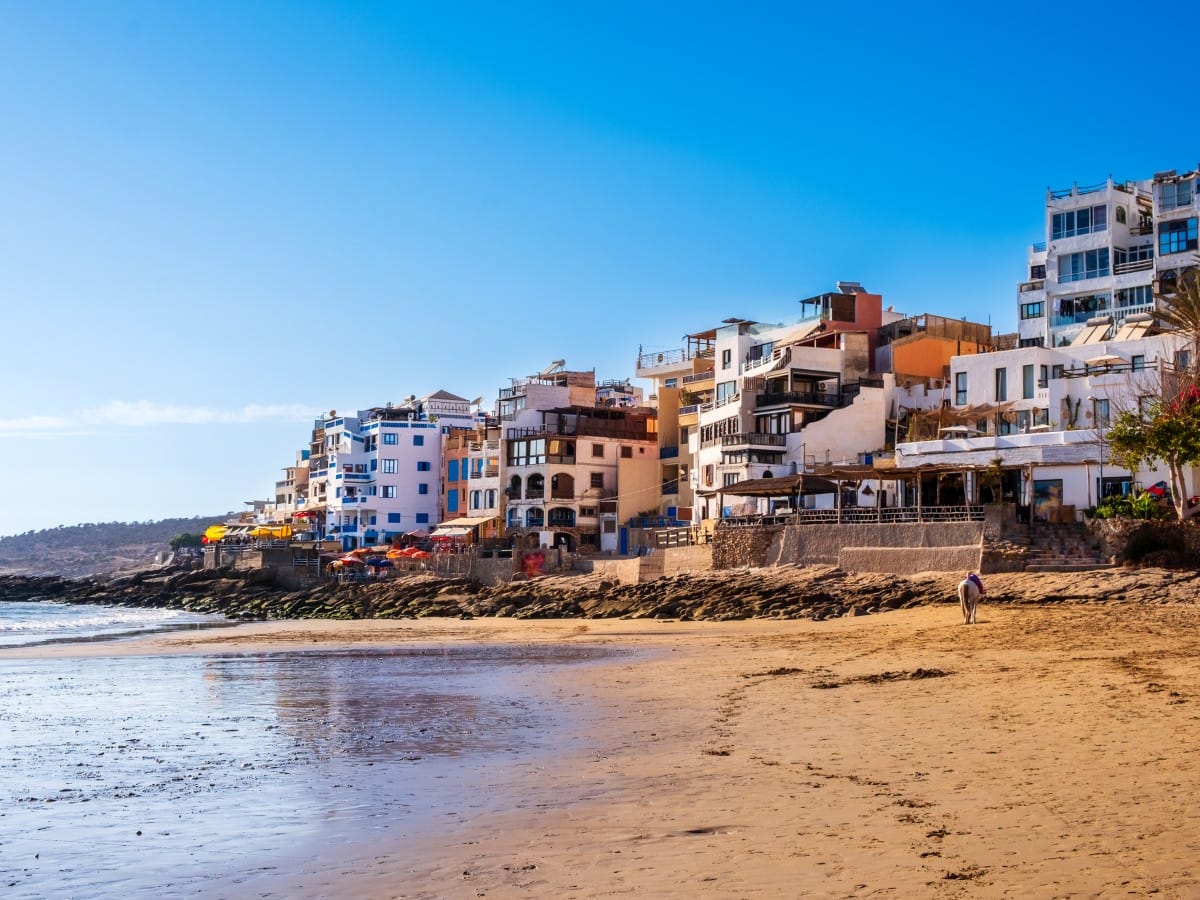
Taghazout is the surf capital of Morocco and it knows it. What was once a sleepy Berber fishing village has become one of Africa’s most well-known surf destinations, with a lineup of world-class breaks, more surf camps than you can count, and a winter season that draws traveling surfers from across Europe and beyond.
It’s not without its flaws. For starters, the lineups can be crowded, and the vibe in the water at the more famous spots isn’t always welcoming (Anchor Point in particular these days). It’s also busy, and loud. On the flip side, the waves are genuinely exceptional, and there’s a fun vibe too, like a mini party, yoga escape with swell.
The star is aforementioned Anchor Point. It’s a long, peeling right that ranks among the best point breaks in Africa and fires consistently throughout the winter on NW swells. North of town, Killer Point lives up to its name with heavier walls suited only to experienced surfers, while the more mellow La Source handles all levels on its day.
Hash Point and Panorama offer gentler alternatives closer to the village center, and the beach breaks south towards Tamraght (see below) give beginners plenty of room to manoeuvre.
There is genuinely something here for every level of surfer, which is ultimately why Taghazout remains the anchor of any Morocco surf itinerary. It’s still a great option and will be for years to come.
Where to stay? Dfrost Almugar Taghazout Villa do one of the best surf camps in the country in our humble opinion.
>>Read our complete guide to Taghazout
Tamraght

Tamraght too often gets lumped in with Taghazout as though it were just a suburb, but it’s its own place with its own personality. It’s especially good for beginner surfers, and it’s arguably the better base for improvers.
The village sits about 8km south of Taghazout, perched above a run of south-facing beaches that are some of the most learner-friendly in the whole country. The surf camps here are excellent and genuinely good value, the accommodation options range from budget hostels to stylish riads,
It’s probably the most accessible, most comfortable introduction to surfing in Morocco that you’ll find anywhere.
The waves themselves are mainly beach breaks. Devil’s Rock and Banana Beach offer mellow, sandy-bottomed waves that are ideal for first-timers and those working on first skills. Crocro hoovers up any and all NW swell throughout the winter and produces reliable chest-to-head-high A-frames that are usually just plain old good fun.
Where to stay? Ocean Surf House is a chilled surf lodging with on-site surf and yoga offerings.
>>Read our complete look at Tamraght
Mirleft

South of Agadir is probably the most untrodden surf region in Morocco. It’s also where you happen to find Mirleft…
A full 65 miles south of Agadir, in fact, it sits on the wild, exposed coastline heading towards the Western Sahara. It still oozes the vibe of a Berber fishing village perched on a rocky headland – paint-peeling, atmospheric, and utterly unlike the more polished surf spots to the north. Van lifers and traveling surfers have been quietly discovering it over the last few years, drawn by the combination of consistent swell, dramatic scenery, and car parks where no one distrubs you.
The surf around Mirleft is genuinely varied and consistently good throughout the winter season. The main beach at Plage Imin Turga faces northwest and catches the full force of Atlantic swell, producing punchy beach break peaks that are best on smaller days and in the morning before conditions get too messy. Plage Tamhrouchte, a short drive south, is the quality wave of the area. It hosts a a long right-hander that wraps off the northern headland and can run for 100 to 200 metres when there’s enough power.
Where to stay? Kasbah Tabelkoukt offers a pool overlooking a beach with surf breaks. It’s luxury and proper cool.
>>Read our complete guide to Mirleft
