
Quiberon Surf Guide: Exploring Brittany’s Wave-Rich Peninsula

Quiberon is one of the lesser known spots of Brittany’s surf scene, offering a mix of powerful beach breaks, rugged coastline, and a solid variety of waves suited to all levels.
While it doesn’t have the year-round consistency of southwest France (places like Landes and Hossegor), Quiberon comes alive when the North Atlantic delivers its long-period swells, which means autumns and winters are the best.
That said, summers can be great, with smaller, easier waves for learners and warmer water all round.
You’ll need a car to get around because the whole region is quite remote. The good news is that it’s not too far to drive here from the ports where the UK ferries come in. Plus, there are now a few good regional airports – mainly Nantes and Brest – that have short-haul connections.
We might use affiliate links in this post. Basically, you click em’ and we get a little something from your booking or purchase. They help us keep offering more and more in-depth surf guides to awesome places all around the globe. So, thanks for that!
This guide is just one part of our complete guides to surfing in Brittany and surfing in France
Surfing in Quiberon at a glance
- Uncrowded waves – Compared to France’s more famous surf regions, Quiberon remains relatively low-key, even in peak season.
- Varied surf spots – A mix of beach breaks and reef setups offers something for all levels.
- Scenic beauty – Dramatic cliffs, golden sand beaches, and a raw Atlantic coastline set the scene.
- Strong autumn and winter swells – Quiberon is best when the Atlantic sends in heavy northwest swells, lighting up its main breaks.
What’s in this guide to Quiberon surf?
Surf spots in Quiberon
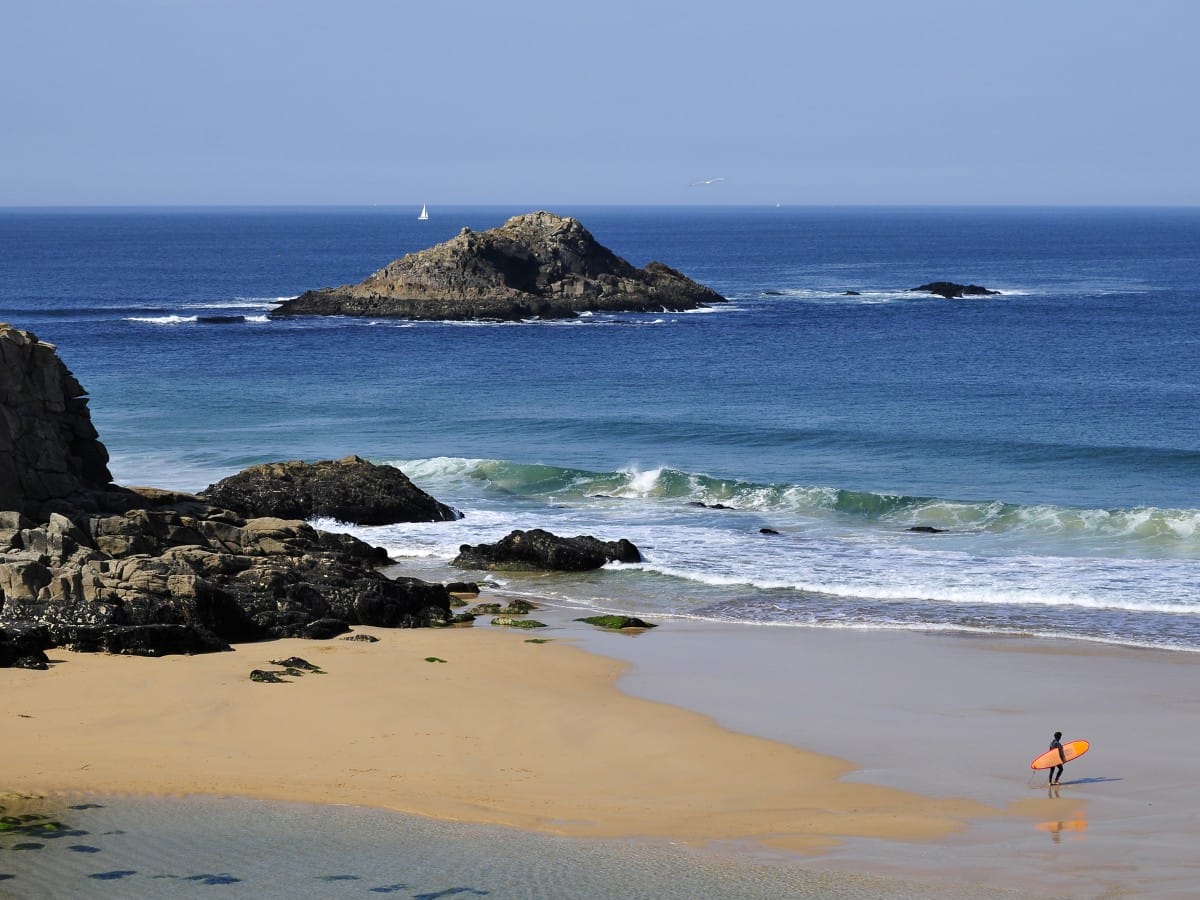
The Quiberon peninsula’s surf spots are all on the western side of the headland. That gets the best swell coverage. We’ll start on the north side of and work our way down…
Sainte-Barbe (Plouharnel)
Plouharnel is the gateway town of the Quiberon Peninsula as a whole. It’s kinda the de facto surf hub of the whole region, and has been called Brittany’s best surf town. We really, really like it cos it’s chill and never as busy as the likes of Hossegor or Guidel.
It’s got access to the long run of strand at Sainte-Barbe, which is about a five-minute drive from the center of the town itself. It’s 2.5 miles of classic north France beach break.
Sand bottomed the whole way along, it’s great for learners on small swells. When it’s over say around 5 foot, then the banks work real nice on a mid tide and give some better-than-average beach peaks that are punchy and fun.
The downside is that this is an exposed spot, so strong winds can blow the whole thing out in seconds.esc
Plage de Penthièvre
Located at the entrance to the Quiberon Peninsula, this long sandy beach is the most consistent surf spot in the area.
It’s got a little bit more westerly orientation than Sainte Barbe to the north of it, so gets a better whack of NW swell and that keeps it running more often in the summer months as well as the winter.
Penthièvre will get windy too. When there’s a big storm the windsurfers and sailors will be out in force. Peaks are similar to Sainte-Barbe: mainly peaky, punchy beach break that can either close out or peel depending on swell angle.
We’d say a good NW pulse is the best. Mid tide is top.
Port Blanc
Port Blanc is one of the most beautiful bays in the whole Quiberon. It’s flanked by low cliffs and grassy clifftop meadows, and has pure turquoise water when there’s no swell around. When there is, it’s a good intermediate spot with punchy A-frame waves. Shorter lefts. Nice longish rights, all workable and rippable on mid tides, a bit fatter at high.
This is a lovely place to surf, and has good protection from north winds if you tuck into the cliffs up on the north end of the beach too.
Port Bara
We’d say that the Port Bara reef break is among the best spots in the whole of northern France. It’s a real nice number that works off some jagged rocks below the cliffs about a third of the way down the west coast of the peninsula.
The spot can hold nice size and is best suited to intermediate and advanced surfers because there’s rock underfoot and rips like hell.
Wait for a higher tide because it’s too shallow on the rocks to ride at low. Usually a locals crowd out but they aren’t so bad.
Côte Sauvage
The Côte Sauvage (“Wild Coast”) on the southwestern edge of the peninsula is home to several reef setups and point breaks. They’re kinda secret and when and how the work is local knowledge.
One thing we can say is that they are almost entirely for the more advanced surfer out there. Get in the car, drive around, ask local surfers – there’s a good chance you’ll find something that’s working well if there’s any SW to NW swell in the offing.
Best time to surf in Quiberon
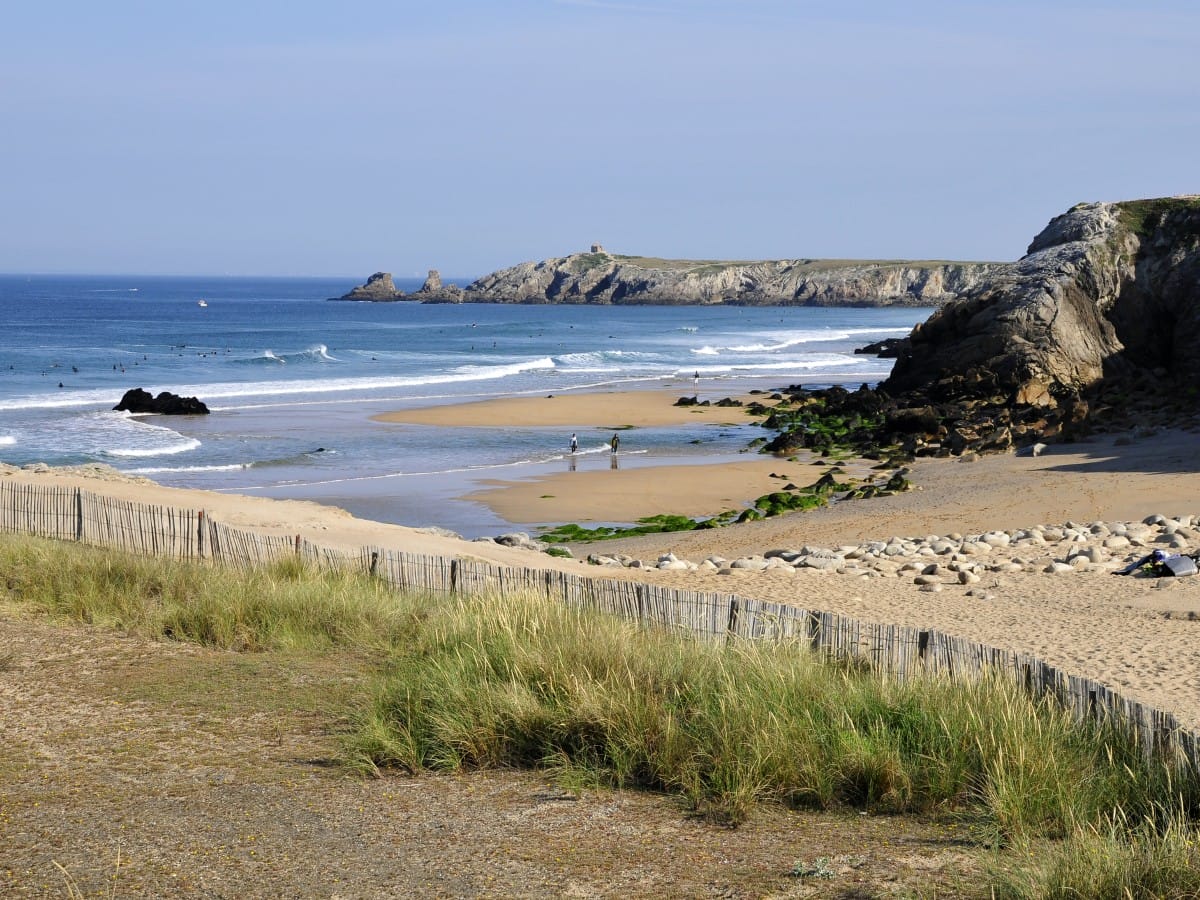
Quiberon’s surf is heavily dependent on North Atlantic swells, with the best waves arriving in autumn and winter.
- Autumn (Sept–Nov) – Consistent swells, lighter winds, and warmer water make this the best season.
- Winter (Dec–Feb) – The most powerful swells, but also the coldest water and frequent storms.
- Spring (March–May) – Still some solid swells, but wind and wave quality can be inconsistent.
- Summer (June–Aug) – Smaller, more beginner-friendly waves, but also the busiest time for tourists.
Water temperatures range from 10°C in winter to 18°C in summer, so a 5/4mm wetsuit is essential for winter, and a 3/2mm will suffice in summer.
Getting to Quiberon (and getting around)
Quiberon is located in southern Brittany, about 1.5 hours from Nantes and 2 hours from Rennes.
- By car – The easiest way to reach Quiberon and explore the peninsula. Parking is available at most beaches. We’d hire a car (we use RentalCars.com mainly in Europe) if you don’t have access to your own.
- By train – The nearest major station is in Auray, with a seasonal connection to Quiberon via the Tire-Bouchon train. Search on RailEurope to pre-book tickets, which are cheaper than ones bought on the day in France.
- By bus – Local buses run between Auray and Quiberon, but schedules are limited.
A car is highly recommended for accessing the best surf spots, especially those along the Côte Sauvage.
We might use affiliate links in this post. Basically, you click em’ and we get a little something from your booking or purchase. They help us keep offering more and more in-depth surf guides to awesome places all around the globe. So, thanks for that!
