
Surfing in Chiba – A Complete Guide for 2025

Surfing in Chiba is perfect for beginning a journey around Japan. This region has some of the most consistent beach breaks in the country and a nice variety of wave types, all within 1.5 hours of Tokyo
An introduction to surfing in Chiba
Chiba is the best surf coast in the vicinity of Tokyo. That means over 24 million people have it on their doorstep, so this ain’t no secret surf region like you might find up in Hokkaido or down in upcoming Shikoku.
But what Chiba lacks in deserted waves it more than makes up for in variety and consistency.
Now, nowhere in Japan has the consistency of Indo but Chiba is your best bet.
It’ll get the full hit of all and any SE typhoon swell in the peak period after August (Sept-Oct is best) but also plenty of stray NE winter swells or windswell systems that roll off the northern Pacific low pressures in winter.
AKA – there are often more surfable days here than just about anywhere in the country. It’s not for nothing that the Olympic planners threw their lot in with Chiba’s long beaches when the time came to showcase surfing to the world back in 2020.
So, what about the variety? Chiba has that in bags. From the long, black-sand beaches of Taito and Shida in the northern parts of the region to the cliff-backed points of Malibu further south, there’s quite a lot to get through and decent waves for all levels of surfer.
To be honest, we’d rate this as the best overall place to begin a surf trip through Japan. It’s accessible – under two hours from Tokyo. It’s well known – Olympic surfing pedigree meets local surf schools and rentals. It’s suitable for all levels. Just prey for a SE swell.
We might use affiliate links in this post. Basically, you click em’ and we get a little something from your booking or purchase. They help us keep offering more and more in-depth surf guides to awesome places all around the globe. So, thanks for that!
This guide is just one part of our complete guide to surfing in Japan
Chiba at a glance
The good…
The bad…
What’s in this guide to Chiba?
Where is Chiba?
A quick hour’s drive or train ride whisks you away from Tokyo’s concrete jungle to Chiba’s sandy beaches and surf spots. That’s it. It’s by far the most accessible surf region from the capital, bar maybe Kamakura to the south of the town.
Chiba is sort of a shoehorn-shaped area with a long bending beach in Kujukuri leading to a more rugged southern half of the prefecture. That east-facing coast is where you want to head for surf.
More generally, Chiba is just to the east of Tokyo, separated by the big city by Tokyo Bay.
If you come in by plane in to Haneda Airport then it’s pretty simple to drive straight to Chiba and dodge having to navigate Tokyo because you can drive straight over the amazing Tokyo Bay Aqua-Line and into Chiba itself from the airport.
We’d recommend taking that course of action. Driving is 100% the best way to do a surf trip in Japan, but driving in Tokyo is hell on earth.
Use RentalCars to hire (we think they are the cheapest) and head straight east from the arrivals terminal to the surf beaches. You can visit Tokyo at the end of your trip after dropping the car off.
Where to surf in Chiba?
 iStock.com / Dane Gillett
Chiba is a goldmine for surfers. If you love wedgy, peaky beach breaks, you’ll love this region, which is largely defined by its long black-sand runs broken by piers and groynes.
We recommend starting at Shidashita where the Olympics were held. It’s now sort of the de facto hub of Honshu/Japanese surf culture, has surf schools and rental spots.
From there, go south to the more rugged tip of Chiba prefecture where you can score more varied point breaks and even some reefs (that area tends to be better for more advanced surfers).
Timing is key – Chiba shines from late August to October.
Kujukuri Beach
Kujukuri Beach is one of Japan’s longest and most consistent beach breaks. All that SE swell hits here head on, while winter NE windswells cut right into the bay – they can be messy but also work well in the off season.
The beach is known for its sand-bottom breaks, making it ideal for beginners and intermediates and there’s loads of space here to spread out and be by yourself, something that you can’t always rely on in Chiba, what with Tokyo so close.
Shidashita (Tsurigasaki Beach)
Shidashita Beach rose to fame as the hosting spot for the surfing in the 2020 Olympics. While conditions hardly impressed like Teahupo’o did four years later, the location is now cemented as the hub of the Japanese surf scene – both in international circles but also in the eyes of newcomer surfers picking up their first board in the greater Tokyo metro area, and there are more and more every year.
Known to the crews here as Shida, it’s two hours by train or 1.5 hours’ driving from the very middle of Tokyo. The upshot? It’s accessible but that means crowds. There’s rarely a day with swell when there’s not someone out in the water in these parts. And when we say someone, we kinda mean a few hundred Tokyo surfers good and bad.
On the flip side, the nature of the spot lends itself to crowds…
This is a long volcanic-sand beach that slopes neatly into the Pacific at an ever-so-slight NW angle. Taito Beach is the name for the southernmost point by the harbor. We’ll talk in more detail about that below.
As far as Shida itself is concerned, the pull is the series of 10 huge piers that run up the four miles of coast. Each one has a left and a right on either side, though the rights will tend to fire best because the key swell angles here are between 112 and 135 degrees ish, so SE head on. They’ll hit the top end of the piers and whack inside to give fun rides that vary a lot depending on how the sandbars are sitting or where the tide is.
Generally, the rule is the further south you head the more shelter you get from head-on SE sets and that means the size can dip maybe 2-4 foot from the northernmost pier to the southernmost and that there’s often something for all levels, from total beginners to more advanced surfers.
If it’s really pumping then tuck right south at…
Taito Beach
Taito Beach is the southernmost point of Shidashita Beach and the most protected spot along this fantastic stretch of Japanese surf coast. The long concrete arms of the Taito Port poke out to offer good protection from wrap-in SE sets, cutting the size down and often tempering the best mid-sized 4-6 foot swells into lovely, clean longboard peelers.
There’s parking right by the Taito pier so this location will get busy and you should consider heading out of Tokyo as early as possible to avoid overcrowding.
Hebara Beach
There’s a sucky wedge in the middle of Hebara Beach that reminds us of that winter barrel that tricks people on Nazare town beach sometimes.
Forget that as it’s by the dirty-ish rivermouth and go to the north end of the beach (there’s usually a line up to show you where), which has some real nice A-frames that love either E or SE swell.
Couple it with a westerly offshore, which can happen in the typhoon season and this will be a very nice spot to behold, good for all levels (depending on size) and receptive to all boards (nuggets up to logs).
Malibu Point
Nope, not California but a homage to the iconic minimal peeler that does grace the coast north of LA. Katsuura’s best break is the right hander that works on the reefs just below the high cliffs on the south side of town. When those SE typhoon pulses push up here this one can go off like a bomb and give fricking lush right barrels that hollow first and then shoulder into a lovely wedge.
It’s been the site of some famous WSL battles and is a stomping ground for the best surfers in Chiba/Tokyo who are generally pretty nice, though scoring a ride can be hard.
Ubara Beach
Track further south again along the now very attractive coast road that runs south from Katsuura and you’ll soon hit the charming beach town of Ubara. It’s got a golden bay of sand out front that bends to face a touch southwest.
That’s away from the prevailing swell but not away enough to mean there won’t be waves in the bay. This one likes some decent size and a direct SE typhoon swell, so that the sets can bend inside. When that happens it’s one of our fav longboard spots in Japan; as pretty as well as fun.
Maebara-Yokosuka Beach
The resort town of Maebara is best known as a chillout spot for summer days when the Tokyo heat gets too much.
One of the reasons for that is the outlying breakwaters, which cut down the swell size a lot in the later summer months of August and September.
The upshot? If it’s 5 foot at Malibu Point then you can score mini 2-foot ankle breakers here that are nice for the log. Usually there’s a crowd out if there’s a wave because it’s the definition of a funwave spot.
Where to stay when surfing in Chiba?

Personally, I’d always look to base myself in the more southern part of Chiba. That’s not because the surf is better. It’s not really – Shida and Taito are the most reliable spots here and they are further north. It’s more because the southern part of the area is generally way prettier, with more attractive coastline and resort towns to return to after days of surfing.
The better option, though, has to be plotting two or three spots in the Chiba region and moving from one to the next. Start at Ubara, then head up to Katsuura and finish somewhere near Shida.
Anyway here are our top surf stays on the Chiba beaches…
- ISUMI Glamping Resort &Spa SOLAS – A pretty cool glamping option that’s on the main highway running from the southern points of Chiba to the more northern surf beaches. They offer fun dome tents surrounded by nature with exceptional views, plus indoor and outdoor pools and a full spa.
- Cottage stay – Close to the Chiba Port Tower and only 38km from Narita Airport, this bungalow is a good first night’s stay for surfing in Chiba. There are endless beach breaks on the doorstep and the pad is really cool, with its own garden, nice kitchen, and al fresco eating space.
A good option for roadtrip planning is to use Booking’s map feature to pinpoint exactly where any hotels are in the Chiba area so that you can stay close to the beach/break or at least know how long you’ll need to go from wave to hotel after a session.
When to surf in Chiba?
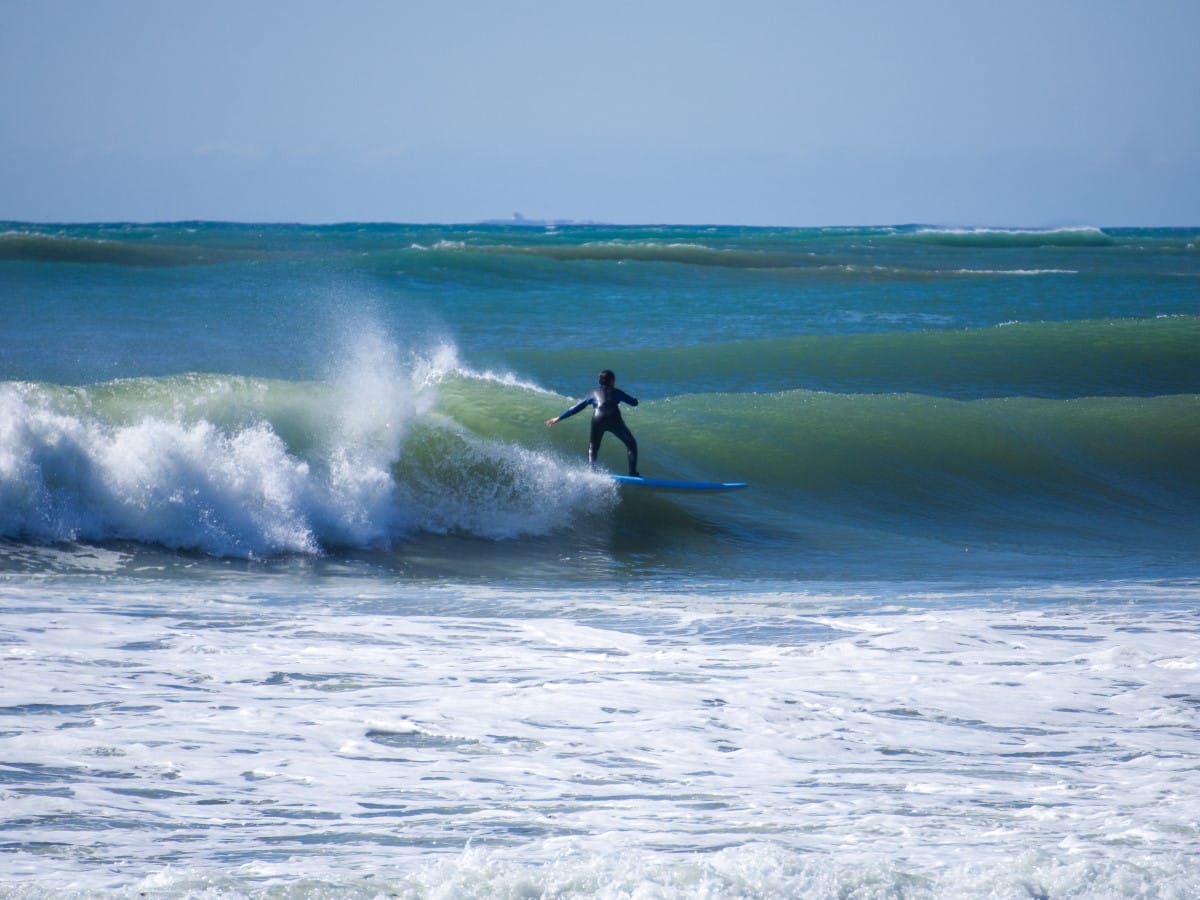 iStock.com / Dane Gillett
Late August to late October is the key time to surf in Chiba. There’s really no other time of the year that can offer the same window of regular SE swell.
It’s still not perfect, mind you. Those SE pulses come off big typhoon storms moving through the lower tropics of the Pacific, and there have been seasons where they’re basically non-existent. But, hey, you don’t come surfing in Japan for consistency.
There can be NE windswell in the winter that will whip up decent sets on the more exposed beaches of Chiba. Those days won’t be clean but they can be punchy and fun around the Shidashita and Kujukuri piers, and even then there’s likely to be a crowd since Tokyo is only an hour away over the Tokyo Bay bridge.
We might use affiliate links in this post. Basically, you click em’ and we get a little something from your booking or purchase. They help us keep offering more and more in-depth surf guides to awesome places all around the globe. So, thanks for that!
