
14 Beaches in Lisbon for Surfers and Non-Surfers


Lisbon isn’t a beach city in the classic sense. It sits on the Tagus estuary, all tiled facades and miradouros, rather than directly on the Atlantic. I actually remember the first time I came here. I headed out for a beer down on the waterside with my Couchsurf host and I was like, oh look the ocean. He corrected me quicker than I sunk my first Sagres.
Initially, it can be dissapointing if you’ve just flown in looking to surf. But Lisbon’s location is actually great. Within 20–50 minutes, you can be standing on wild, cliff-backed surf beaches, sheltered town coves, or long, dune-lined stretches that feel properly untamed. There’s something for everyone.
There are three main beach zones to know:
Head north and you hit the Sintra Coast – dramatic, exposed, and often the best for surfing.
Stick west along the train line and you’re on the Estoril Coast – more sheltered, easier to access, great for a quick dip on a city break, but also with its own surf spots.
Cross the bridge south and you’ll find Caparica and the beaches around Sesimbra. These are long, open Atlantic sands mixed with tucked-away turquoise coves.
Below, we’ve broken down 14 of the best beaches in Lisbon by region, with honest takes on what they’re like and whether they’re actually worth taking the board to.
We might use affiliate links in this post. Basically, you click em’ and we get a little something from your booking or purchase. They help us keep offering more and more in-depth surf guides to awesome places all around the globe. So, thanks for that!
>>This is just one part of our complete guide to surfing in Portugal
Beaches north of Lisbon (Sintra Coast)
North of Lisbon lies the Sintra Coast. This is a raw, dramatic, and properly Atlantic region. All its beaches are about 30 to 50 minutes by car from the city and feel a world away from the big city.
Cliffs tower above the sand, swell rolls in clean and powerful, and the wind can be relentless. It’s like proper surf country, but access isn’t always easy.
You’re best off with a hire care, some beaches require steep paths or winding mountain roads, and it’s kinda easy to get lost, even with a sat nav on the go.
Praia das Maçãs

Praia das Maçãs is one of the more accessible Sintra Coast beaches. There’s even an old-school tram that rattles down from Sintra town in summer, dropping you right near the sand. Compared to some of its wilder neighbours, this one feels almost civilised.
It’s a broad-ish sandy beach framed by cliffs, with a small town behind offering cafés and seafood spots that pepper the whole promenade. In summer, families fill it up. In winter, it takes on a more rugged feel, with big Atlantic lines marching in and lots (like LOTS) of wind.
The beach breaks here can be punchy, especially when the swell is up. It’s not always beginner-friendly, but on smaller days it’s manageable. More options await around the corner in Praia Grande.
My two cents: The fact that Praia das Maçãs is actually a whole beach towns means I really like it as an option as a base for a holiday. You can stay here, visit Lisbon itself, but also travel to some great surf beaches up and down the Sintra Coast.
The surf? You mainly surf Praia Grande to the south, which has consistent, exposed beach break the whole way along. Can be powerful and rippy; better for intermediates on bigger days.
Praia Grande

Praia Grande is exactly what the name promises: Big. Wide, open, and dramatic, it’s one of the flagship surf beaches near Lisbon and on the whole Costa Sintra. The cliffs are huge (and even have dinosaur footprints on em!), the sand stretches for ages, and the Atlantic hits it square on, so there’s lots to surf.
This place has even hosted surf competitions, and when it’s on, it’s properly on. Thick peaks wedge up across the sandbanks, and there’s space for multiple lineups. Even when it’s busy, it rarely feels cramped because the beach is so expansive. Most hire spots are towards the north part of the bay, so walk south to get away from the crowds.
It’s less about sunbathing and more about the ocean. Winds can whip through, and winter swells can be realllly strong. In summer, it mellows a little, though there’s almost always some kind of wave on offer.
The surf? One of the best and most consistent surf beaches near Lisbon. Powerful beach break, often suited to intermediates and up, though does mellow out in summer.
Praia da Adraga

Praia da Adraga feels cinematic. Rock stacks rise from the sand up to the high cliffs looming overhead, while the road down twists through the Sintra hills before suddenly revealing the Atlantic. (I’d highly reccomend making the drive even if you don’t want to surf/sunbathe – it’s a corker!)
It’s smaller than Praia Grande but more photogenic. In summer, it attracts day-trippers and sunset chasers. In winter, it’s raw and wild, with some good watching as the waves explode against the rocks.
Swimming can be tricky when there’s swell, and currents can shift quickly. It’s not a beginner-friendly beach in rough conditions. But for a beach day with drama, it’s hard to beat. Bring a picnic, nothing in the vicinity for food bar one seafood restaurant (and I’m veggie).
The surf? Exposed and often heavy. Can offer decent peaks, but currents and rocks mean it’s better for experienced surfers and locals, who know where the reefs lay. The lefts at the south end of the bay can be especially good.
Praia da Ursa

Praia da Ursa is the wild card. Often cited as one of Portugal’s most beautiful beaches, it sits below towering cliffs near Cabo da Roca. They fragment off the shoreline here like arrowheads, and tower right over the rock.
Even the walk in is an adventure. Getting to the beach involves a steep, loose path that’s not for flip-flops. Parking is on offer in the village just above.
The payoff is worth it, tough. Those Jagged rock spires jut from the sand, the water glows a deep blue thanks to the fringing of reefs (not sand, which can make the water murky), and there’s a sense of proper remoteness.
It feels more like something off a Greek island than mainland Portugal.
There are no facilities, no bars. Bring your own food – and, I’ll reiterate – suitable footwear!
The surf? Not great for surf. Beach is too tight and rocky.
Beaches on the Estoril Coast
The Estoril Coast runs west from Lisbon along the train line toward Cascais. These beaches are easier to reach – many are walkable from stations – and tend to be more sheltered thanks to the curve of the coastline.
The waves are generally smaller and more forgiving than up on the Sintra Coast, making this stretch good for quick swims and beginner-friendly surf on the right days.
There are some exceptions, of course: Carcavelos can barrel, and the beaches will get real heavy on the biggest NW-SW pulses.
The Estoril is best seen as Lisbon’s beach backyard. You can come here on trams from the city with ease.
Praia do Guincho

We should, probably, put Praia do Guincho in the section above, since it’s a west-facing beach with open exposure to the Atlantic. However, it’s technically a part of the Estoril Coast, and we’re sticklers for categories. So, here it is.
Guincho is a gorgeous bay where you can see the high cliffs that define the Sintra region starting to form to the north. It’s got a long, sandy beach front with loads of surf peaks.
However, it’s also famous for wind. On many afternoons, the breeze howls, drawing kitesurfers and windsurfers. You’ll need to hold out for windless days or rare easterlies to catch clean swell here, though that rarely matters to the surf schools who so often come this way to chase whitewash.
The surf? Exposed and consistent. Can be excellent, but wind is a major factor. One of the most-surfed beaches in the Lisbon region and often used by surf schools out of the capital and Cascais.
Praia da Rainha

Tiny and picturesque, Praia da Rainha sits right in the middle of lovely Cascais town. It’s wedged between rocks and accessed by steps from the promenade.
This is more about charm than space. It fills up quickly in summer, but the setting – rthink golden sand, calm-ish water, pastel buildings behind – makes it a favourite for photos and quick dips.
A lot of people say it reminds them of an Algarve beach that’s been plucked up and plonked down here near Lisbon. I can see why – it’s got that sort of vibe.
Personally, I’ve enjoyed many a pastry and morning coffee here, and some nice long evening sessions with a few cold beers.
The surf? Not really a surfing beach. Urban beach in Cascais.
Praia da Ribeira

This is the other beach in Cascais. It’s right in the centre, too, just along from Praia da Rainha, which sits just to the south.
Charms aplenty: Fishing boats bob nearby, restaurants line the square above it, and it feels properly integrated into the daily rhythms of the town.
It’s calm and sheltered, too, making it good for families and relaxed swims. You won’t find pounding surf here since the Cascais harbor and the main headlands that end the Estoril Coast keep it nice and protected.
It’s the kind of place you wander down to after lunch, towel over your shoulder and book in hand.
The surf? Not a surfing beach.
Carcavelos
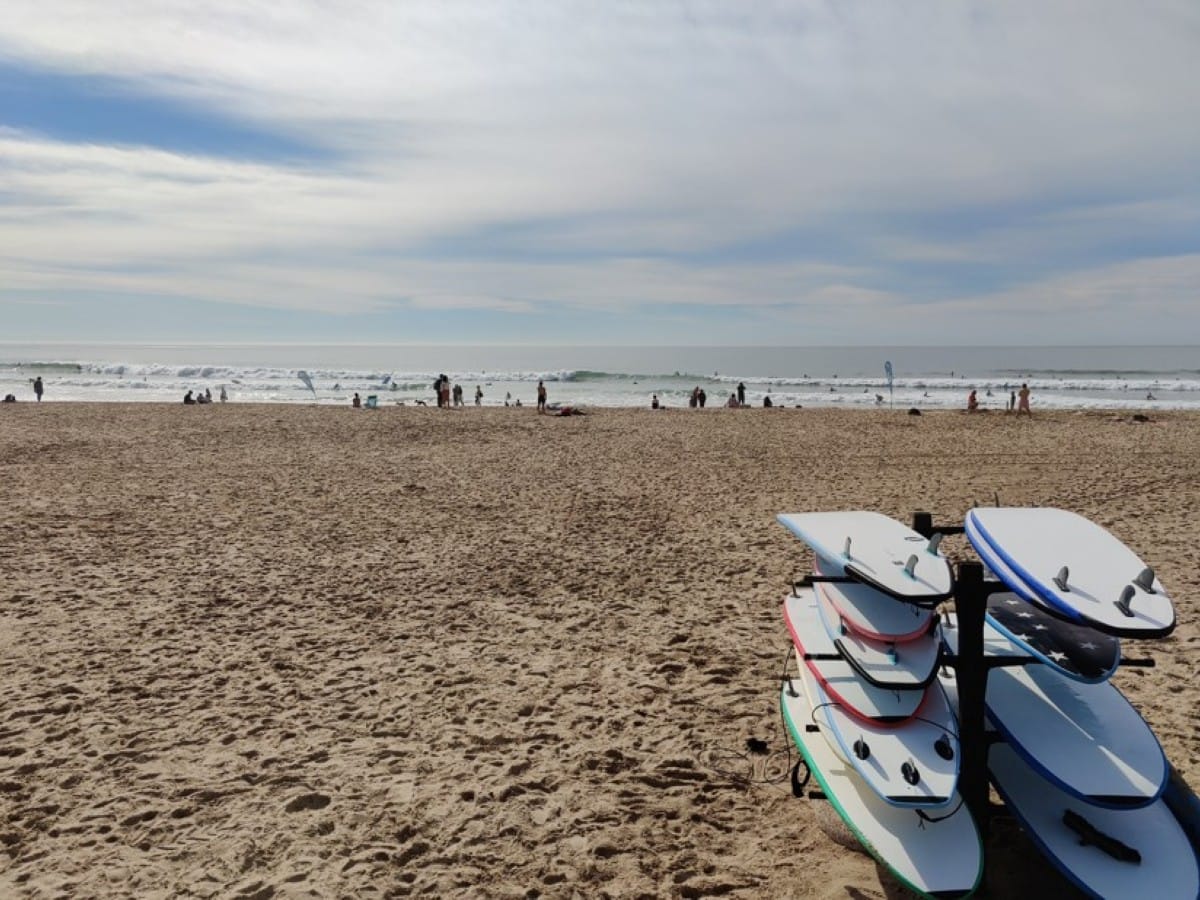
Carcavelos is very much the heavyweight of the Estoril Coast. Big, open, and directly on the train line, it’s Lisbon’s most accessible proper surf beach.
That means one thing: Crowds. The lineup can be busy pretty much all year. Any whiff of swell and the schools and the locals will be out in force, and they’re not the friendliest locals to say the least ;). In winter, solid swells wrap in and produce powerful rights on the reefs on the outside that will barrel. In summer, it softens up, making it a go-to for learners.
You can come to hang out and chill but I’d say there are better beaches for that.
The surf? One of the best surf spots close to Lisbon. Consistent beach break with quality peaks, suitable for all levels depending on conditions.
Where to stay near Lisbon’s beaches?
- 🏨 Hotel Fortaleza do Guincho Relais & Châteaux – Treat yourself to this world-class hotel overlooking the waves of Guincho Beach. It’s got a stunning mudejar style, a spa, and a cracking restaurant.
- 🏄The Salty Cascais – A boutique surf camp in an historic Cascais townhouse offering loads of yoga, good surf teaching, and great vibes.
- 💵Lisbon Surf Hostel – One of the best surf hostels in Portugal. A fun spot within walking distance of Carcavelos beach, which has plenty of surf.
Praia de Santo Amaro

Praia de Santo Amaro, in Oeiras, is a broad, S-bend of a beach that’s got a lively promenade lacing its back. It’s a classic after-work beach in summer, filling up quickly with Lisbon locals and vacationers out of nearby Cascais, which is even closer than the capital.
There are cafés and restaurants galore, and the vibe is social rather than rugged. The water way calmer than the Sintra Coast, making it more inviting for casual swimmers.
It’s not the most dramatic beach in Portugal, but for convenience and atmosphere, it ticks a lot of boxes.
The surf? Can get small, soft waves on the right swell, but generally better for swimming than surfing.
Praia de Caxias

Praia de Caxias is one of the first beaches you hit heading west from Lisbon. It’s small, tucked between breakwaters, and feels more local than showy.
The train runs right behind it, which makes access simple but also gives it a slightly urban edge. On sunny days, locals pop down for a quick swim or to catch some rays without venturing far from the city.
It’s not huge and not particularly wild, but that’s kind of the point. It’s a convenient, low-effort beach.
I’ve actually walked here from Lisbon before. It takes like an hour along the coastal road from the Belem Tower.
The surf? Generally small and inconsistent. Not a major surf beach.
Beaches south of Lisbon
Cross the 25 de Abril Bridge (the one you can see from all the lookout points in Lisbon) and the landscape shifts. The Costa da Caparica runs for miles along the Atlantic there, backed by dunes and pine forests and the occassioanl surf town.
Further south toward Sesimbra, the coastline turns more rugged again, with turquoise coves and sheltered bays.
These beaches are more exposed than the Estoril Coast but generally easier to access than the wilder Sintra spots. They are also something of a hidden gem, ready to reward anyone who rents and car and drives maybe 50 mins.
Costa da Caparica

The Costa da Caparica isn’t just one beach. It’s a whole coastline. The long, sandy powerhouse of surf and chilling sits just 20-30 minutes from Lisbon’s center, too. You can even Uber there if you want to.
The beaches stretch for miles, with gazillions of peaks along the way. The north end has breakwaters that offer different lefts and rights off each side, while the south is more about sandbanks that will change each season.
Near town (the main town of Costa da Caparica that is) it’s lively and lined with bars. The further down you drive, it gets quieter and more dune-backed. There’s almost always a wave somewhere along this stretch, which makes it a favourite with Lisbon surfers.
The surf? Consistent beach break with multiple peaks. Suitable for all levels depending on the specific spot and swell.
Praia do Ribeiro do Cavalo

This one looks more like Zante than Portugal. Praia do Ribeiro do Cavalo sits in a turquoise cove near the town of Sesimbra, hemmed in by steep cliffs on all sides, bar the one with the sea, which glows gorgeously aquamarine from like May onwards.
Getting down involves a tough, loose walk, or you can come by kayak or boat taxi. That effort keeps the crowds lower than you’d expect given how beautiful it is. The spot is also like 50 minutes’ drive south of Lisbon, so city slickers aren’t so likely to drop by.
For me, Praia do Ribeiro do Cavalo is probably the most WOW beach in the whole of Central Portugal. It’s not great for surf, granted, but it can’t be beaten for sheer beauty.
The surf? Not a surfing beach. Sheltered cove with minimal swell from dominant Atlantic NW. Plus, there’s really tricky access.
Praia do Ouro

Praia do Ouro curves around the main harbour in the town of Sesimbra, forming a sheltered urban beach with calm, inviting water.
It’s family-friendly, easy to access, and backed by restaurants and cafés. Compared to the open Atlantic beaches, it feels much gentler. That results in an almost-constant crowd throughout the warmer months, but it’s okay cos that’s what you come here for: Vacay vibes.
The surf? Don’t surf here.
Praia da Califórnia

Basically at one with Praia do Ouro, Praia da Califórnia sits on the other side of Sesimbra’s big fort. It’s similarly sheltered but slightly more open to the Atlantic, though still has the same sort of feel to it: It’s family friendly, good for chilling, though probably just a touch quieter.
If I was being REALLLYY picky, I’d say that the way the hotels loom really close to the water here makes it feel almost like sitting under a cruise ship. But the setting is gorgeous still – think cliffs rising behind town, clear water, and a lively promenade. In summer, it’s busy but cheerful.
The surf? Usually calm and sheltered. Not a reliable surfing beach.
