
Lisbon Surf & Travel Guide – All You Need to Know for 2026

It’s not actually that common for surfers to plan surf trips in Lisbon itself.
Most aim for the likes of Ericeira or Peniche, or even the Algarve, which are between one and three hours from the captial. They just Lisbon as a simple entry and exit point. We can understand why. Lisbon doesn’t have the best waves in the country. However, it’s not bad by any stretch.
You’ll find a whole medley of pretty darn awesome spots to hit in the vicinity, along with some that are just a short train from the buzzy, culture-packed downtown.
The upshot? This is PERFECT if you want a city break and surf destination in one, with museums to blow the mind and waves aplenty.
The Costa Estoril is the jewel in the crown when it comes to Lisbon beaches. That strings westwards from Lisbon central and bends around a small headland that shelters the Tagus from oncoming Atlantic swell. The moment you’re past that, you’ll encounter fantastic places to surf, not least of all the punchy beach breaks of Carcavelos – one of the best in the region.
If you’re willing to head further afield, it’s a good idea to have your own car or to check out the surf camps we list here. That’s because you’ll need to be able to drive or travel to seek out more hidden areas like Guincho and the Costa da Caparica.
We’s say that its 100% worth doing for at least a few days of distraction from the big city. The undercurrent of localism, ridiculous line ups and – more recently – water quality in Carcavelos means you’ll probably want to look elsewhere pretty soon.
We might use affiliate links in this post. Basically, you click em’ and we get a little something from your booking or purchase. They help us keep offering more and more in-depth surf guides to awesome places all around the globe. So, thanks for that!
>>Be sure to check out our full guide to surfing in Portugal!
Surfing in Lisbon at a glance
Wave type: Beach breaks // Season: All year // Best for: Intermediates
The good
- Loads of beaches to pick from within an hour’s drive of the city
- Combine a city break in an awesome European capital with surfing!
- Cheap rentals and accessible urban surf spots
The bad
- Weak summer swells on the Estoril coast
- Localism – the city folk think they own these breaks and can behave like arses.
- Some pollution issues closer to the city
Where to surf in Lisbon?
You can break Lisbon into three surf zones…
The first – and the closest to the capital – is the Estoril coast. It’s the stretch of shore that goes from Lisbon to Cascais, all linked by direct urban train lines that cost only a few euros.
Then you have the shores to the north. They are swell magnets, thanks to westerly orientation on the Atlantic.
Finally, there’s the veritable surf playground south of the Tagus. A 30km beach break starts the ball rolling there and you get spots that have just a fraction of the crowds. That area’s collectively known as the Costa da Caparica.
Surf spots to the west of Lisbon (The Estoril Coast)

Carcavelos
Carcavelos is probably the most famous Lisbon surf spot. It’s a legendary urban break that’s practically within city limits – just hop on the train at Cais do Sodré and you can be there in 20 mins (the ticket is 2 EUR each way).
The waves are fantastically consistent, mainly becuase Carcavelos works on both NW and SW swells. That opens the summer and the winter, with the latter being better for experiened riders.
Waves differ across the bay. The east end holds more shape and size, offering hollow lefts under the old fortress. They are fast and slabby at points, with hard drop ins if you come straight off the lip. Middle of the beach mellows slightly and can throw in right handers when the swell is more W-NW.
Warning: there are ALWAYS crowds in Carcavelos. We visited in Oct 2020 and the numbers in the water were nothing short of ridiculous. Locals will cut you up and fling boards as bad as the kooks and still try to blame you for it. But thems the rules and what you gotta’ put up with for world-class waves so close to downtown Lisbon.
>>You can check our complete guide to Carcavelos surf right here
Bafureira
The section of reef that pulls off the headland just around from Carca is what offers the wedge lips of Bafureira. Best for intermediate riders and up, the spot needs good paddle power for a quick drop in zone that leads to A-frame lefts and rights. Watch out for rips, localism, and shallow boils.
Sao Pedro
Sao Pedro is one of the more secret spots on the Lisbon coastline after Carcavelos. It works best on SW swells, so mimics the feel of an Algarvian break on stronger summer days.
Can be hollow and fast, but also mellow and mushy – it just depends on how much punch there is. Also worth a look in on big NW days when the Atlantic coast to the north is blown out.
Poca
The XL star of Lisbon is probably Poca. It’s a rocky reef on the Estoril coastline west of the capital that need some strong Atlantic pulses to get working. When that happens, it’s for experienced surfers only thanks to high, wally waves that dump into shallow rocks.
Cascais
Cascais is a chic beach town and the home of some of the most famous Lisbon beaches of all. It’s linked directly by train to the heart of the capital, so getting here should be a cinch.
There are actually a handful of designated surf spots in the town itself, although they are largely flat in the summer thanks to the Estoril headland. So, most serious surfers head for Guincho or Carca. Others won’t mind the more chilled waves of Praia das Moitas and the more local breaks.
Where to stay? The Salty Cascais – an elegant surf camp in a classic Cascais mansion.
>>We’ve also got a complete guide to Cascais surf right here
Surf spots to the north of Lisbon

Praia do Guincho
The wide and beautiful bay at Guincho is one of the first of the Lisbon beaches you come to as you bend around the point of the Estoril coast.
That means it’s the first place you’ll pick up the full whack of the dominant N-NW Atlantic swell. The result? There’s extra size here, and amazing reliability – most of the summer months are surfable.
There’s always crowds when it’s working well, but its a favoured stomping ground of surf schools so don’t expect too much trouble with localism.
Winter swells mean Guincho gets quite gnarly on 10-foot days. I’ll be heavy with big rips then.
>>Read our complete surf-travel guide to Praia do Guincho
Praia das Maçãs/Praia Grande
Two spots separated by a rugged headland just below the soaring peaks of Sintra – sounds good, eh? There’s better news…these are among the most consistent surf spots int he whole Lisbon region. That’s largely thanks to their slight NW orientation. It pulls in any direct corss Atlantic swells and means those summer easterlies are square offshore. Winter is the best time, but watch out for strong winds that will blow the lot out. Macas has a little issue with localism, but Playa Grande is a real fav among Lisbon surf school attendees, many of which catch their first wave in these parts!
Ericeira
Ericeira is a surf town all on its own. There are direct buses from the capital that take around 1.5 hours but the drive is much shorter. It’s also one we’d totally recommend making if you’re planning a holiday to check out the very crème-de-la-crème of the region’s.
That’s because Ericeira has some of the most fantastic breaks in the region. There’s sand-bottomed Foz do Lizandro for the beginners, along with tubular Coxos for the pros. It’s endless. It really is.
Where to stay? The Salty Ericiera do beginner-friendly camps with a fantastic yoga offering.
>>We have a complete ultimate guide to surfing in Ericeira
Surf spots to the south of Lisbon

Costa da Caparica
Costa da Caparica is actualy an umbrella name for a whole string of beaches that run to the south of Lisbon.
Over this side of the Tagus Estuary things are noticeably quieter. You’ll rarely get the grouchy urbanite crowds of Lisbon to content with, and there are tens of km of sandbar waves to enjoy, with a pleasant backing of cork and pine trees.
Places to have on the radar include the Cova do Vapor – a jetty break that runs left off the very end of the Costa da Caparica with a sand bottom and nice hollow shapes. Praia da Rainha is better for beginners because it doesn’t wall up like the breakwater points on the north end of the sand.
I usually recommend having your own car to explore this region to the full. Or, book onto a tour with one of the local Lisbon surf schools.
Where to stay? Gota Dagua Surf Camp – surf lessons and accomodation are included in this well-priced surf camp on the Costa da Caparica.
>>We actually have a complete guide to surfing on the Costa da Caparica
Lagoa de Albufeira Beach
The big rivermouth at Lagoa de Albufeira Beach helps to organise the sandbars to offer some good wedgey waves. When they’re good and on a NW or SW swell, these are punchy A frames that offer nice fast rides.
On smaller days they can be rippable and mellow rides. The best thing? This is quite far from Lisbon – at least a 40-minute drive from the downtown. That means the big crowds of the Carcavelos surf should be a distant memory.
Come to get sets to yourself – a rare thing in Lisboa!
Bicas
Bicas is an unreliable but powerful point break that forms off the southern end of the Costa da Caparica. Works well on direct W swells but hits its heights on a winter NW with a max out of around 12 foot. Look for the easterly offshores and expect a tricky paddlout.
When to surf in Lisbon?

The autumn months of September and October are probably the best time to surf in Lisbon, but you can get surf pretty much all year round here.
Lisbon gets surf all year round. The autumn to the spring tends to bring more reliable swell, and waves hit a peak in size in the middle of the winter months, when it can be 3x overhead in Carcavelos and at Poca.
The summer is the key time for beginners, especially along the well-exposed beaches of the Costa da Caparica and in Ericiera – one of Portugal’s top learn-to-surf destinations.
Here’s a closer look at all the various surf seasons and what they mean for the waves in Lisbon…
Autumn (September-November)
It can take a while for the cold of winter to set in over Lisbon. Still, autumn is marked by a general increase in swell size and a decrease in water temperature. Don’t worry, you’ll still be in 4/3 and without boots and a hood in November. A lingering SW swell can help Estoril spots get going in autumn, but big days are to be expected on the Atlantic towards the end of the season as the sets start coming in from the north-west.
Wear: 4/3
Summer (June-August)
Summer is prime time for total beginners looking to hit the Lisbon surf school groups. Everywhere, from Ericeira to the Costa da Caparica is smaller than it is in the winter. Cut swell sizes mean much more approachable waves, but also the danger of pancake days. That said, we don’t think flat lulls are such a problem in Lisboa because there’s so much culture and history and nightlife to get through when the waves aren’t on.
Wear: 3/2 or 2mm
Spring (April-May)
Spring offers good consistency on the Lisbon beaches when it comes to surfing. A nice mix of groundswell and wind swell means that there’s usually a wedge to ride within the mouth of the Tagus estuary. Meanwhile, the tail end of winter storms can fire up huge wedges and barrels in the Costa da Caparica and up near Ericeira. Crowds are also WAY smaller than in the height of the summer.
Wear: 4/3 and keep the boots/gloves handy
Winter (December-March)
Wintertime Lisbon surf is best for expert and experienced riders. Stronger winds will often blow out the Atlantic but there can be regular barrels and fast and hollow rides from Guincho to Coxos when those go easterly (offshore). The Estoril coast tends to be fantastic in the winter with Carcavelos offering slabby lefts off the fort and the reefs nearby getting big and punchy.
Wear: 4/3 or up to 5/3 if you feel the cold. Gloves and hoods a good idea to have along
Where to stay in Lisbon
Surf camps in Lisbon

Most surf camps in Lisbon aren’t actually located in the city. That’s because Lisbon sits on the Tagus estuary not the coast. So, you’d need to either drive or hitch transport to a beach to surf and that can take anything between 30 minutes and1.5 hours depending on where you’re aiming for.
That’s one of the reasons we actually think a surf camp is a top choice here. These packages are either based super-close to the waves or offer transport to them, not to mention surf tuition and whatnot.
The one downside is that they will probably take you away from the core of the city center to towns like Cascais or Costa da Caparica. That’s no biggie, though – just tack on a day or two in the downtown once you’re done surfing or use the decent public transport to go sightseeing whenever you want. That’s what we usually do.
- The Salty Cascais – A really nice surf lodge in the regal town of Cascais only 30 mins from Lisbon on the train. Stunning pool, regular yoga, and 2x full days of board rental in Guincho are included.
- Surf Cascais – Tailored to learner and casual surfers. The main highlight is the overall vibe of the place. You’ll be glugging Sagres with other surfers (read: mates for life) in no time at all.
>>Check our list of the top surf camps in Portugal for more inspo
Hotels and hostels for surfers in Lisbon
Whether you’re on the hunt for a Lisbon surf villa or a sleek boutique, you can rest assured that the Portuguese capital has something on the menu.
In fact, we’d go as far as to say there’s one of the best accommodation selections in the whole of Europe for surf travelers in Lisbon…
- AlmaLusa Alfama – I’m going to from AlmaLusa in here because it’s not all that far from the train station at Cais de Sodre, which is where you get on the train to Cascais and Carcavelos. That means it’s an amazing option if you prioritize sightseeing and urban fun, but do want good access to the surf. More than that, it’s downright classy. Like…LOVELY. Great choice for couples.
- Lisbon Surf Hostel – The bargain option. Great if you’re on a budget. Stay in pod-style posh-tel beds only 20 minutes’ walk from the Carcavelos breaks. Awesome vibes, especially in the summer when good groups of learner surfers come through.
- EVOLUTION Cascais-Estoril Hotel – This IS NOT in Lisbon but rather in the nearby town of Cascais, which is a better base for surfers overall. It’s only 30 mins from the big capital though, and is really nice – infinity pool on the roof, Scandi-cool design sort of nice.
>>We also have a complete guide to all the top surf hostels in Lisbon.
Surf lessons in Lisbon

One thing we love about surfing in Lisbon is that you can work it into a 48- or 72-hour weekend break no problem. There are now stacks of surf schools in the surrounding region that offer guided surf packages that last half or full days. They make it super easy for you to get on the waves as part of your long weekend, with a pick up in the center and a drop off there later in the day.
- Get Stoked – These guys run 2-4-hour options with various meeting points. They’ll whisk you across the Tagus to the Costa da Caparica and get you out on the water with a fully qualified instructor. All equipment included. Prices start at around $35 per person.
- Carcavelos Surf School – Includes two hours on the water of either their home break (Carcavelos) or down on the Caparica Coast. They run a slick outfit and have plenty of gear, which is why we usually recommend it for bigger groups, stag dos, and families.
Surf shops in Lisbon
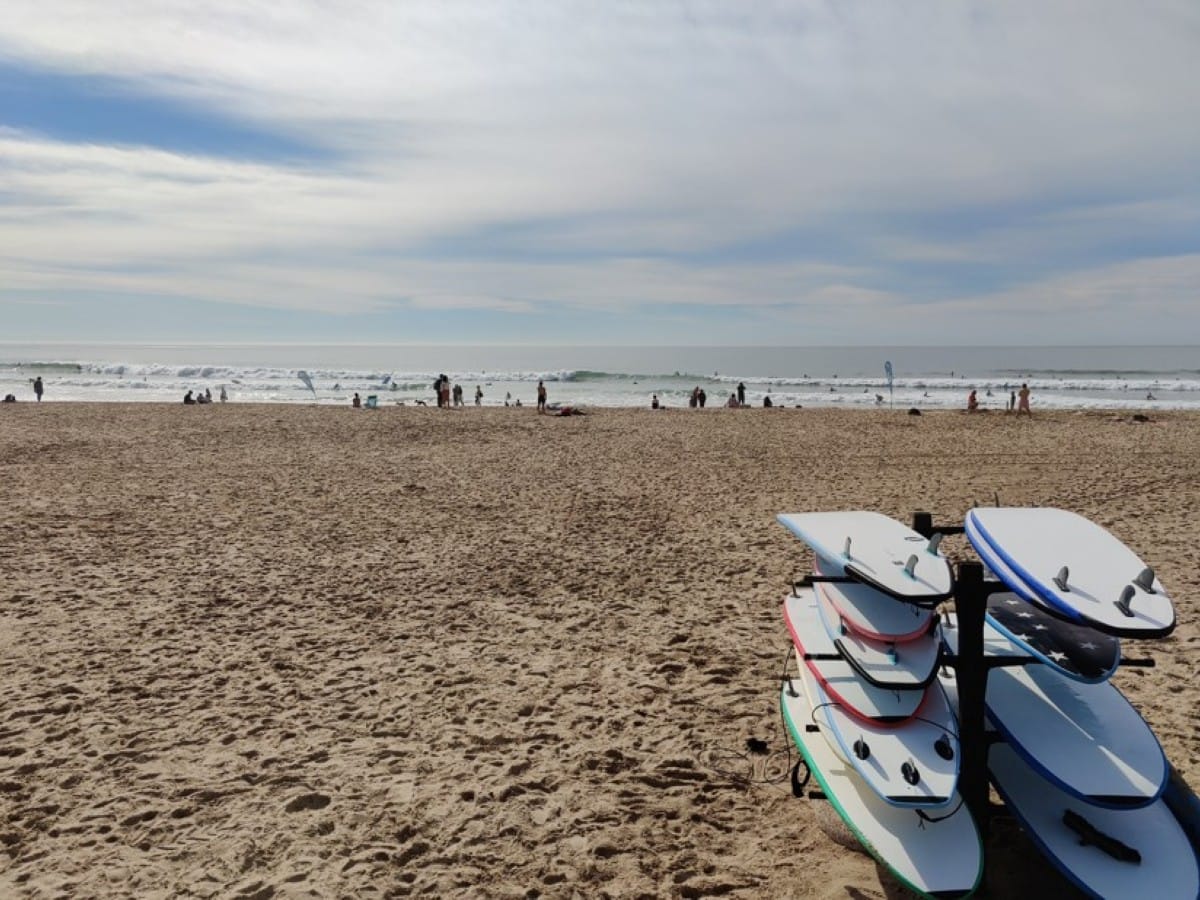
You’ll never be too far from a surf shop in Lisbon. There’s an abundance right behind the beaches to the west, but you can also catch em in the city centre. A few of our humble recommendations are…
- Sunshaka – I like dropping into this casual surfwear shop on Av. Álvares Cabral. People are always nice and there’s some good gear in there.
- Quiksilver Carcavelos – Sat right on the prom right behind arguably the most popular of all the Lisbon surfing beaches, this official Quiksilver outlet has all the gear you could need, provided you’ve got cash to splash. The good news is you know everything’s authentic. Wetsuits, surf fashion, socks – you name it!
- 58 Surf – One of the main names of Central Portugal, 58 Surf have a place on the Costa da Caparica to the south of Portugal. Solid board selection, and staff who actually know the local breaks.
- The Base Surf Store – If you’re serious about getting a new setup then I implore you to leave the city center stores (which are touristy really and more for fashion) and head to The Base Surf Store. It’s on the A5 about 30 minutes from the downtown but has racks of second-hand boards, new Rusty, Chilli, and Wanted boards too.
Travel essentials for Lisbon
Where is Lisbon?
Good question!
Lisbon is the capital of Portugal. It sits on the north side of the Tagus River estuary roughly one third of the way between the Algarve and Porto (the second-largest city that’s far in the north).
The sprawl of the metropolis extends along the Tagus water to the east and a little to the west, before giving way to the Estoril coast, which is where much of the best surfing in Lisbon takes place. There are also suburbs and surf towns to explore to the south and the north, on the wilder Atlantic.
How to get to Lisbon?
Easy peasy. Lisbon – as the capital – is the easiest place to reach in Portugal. That’s largely down to its international airport, which is the largest in Portugal.
I usually just grab a taxi or an Uber when I arrive here – it’s like 15-20 minutes from the airport to the downtown, where you can get onward urban train links to Cascais.
Lisbon also has direct train links to Porto in the north and the Algarve in the south. You can pre-book tickets on those, or on international buses that come across from Spain using RailEurope.
Do I need a car hire to surf in Lisbon?

A car hire isn’t required if you’re simply planning on surfing the Estoril Coast (Carcalavelos, for example). You can stay in the city and train your way up there from Cais da Sodre station whenever you like. You also won’t need to hire a car if you’re planning on doing a surf camp here. They all take care of transport to and from the various breaks.
We would recommend wheels of your own if you’re only reading this guide because you’re putting together a larger Portugal surf trip and want to know what breaks are on offer around Lisbon. More than that, renting from the city makes sense because the bulk of the car hire outlets are based around Lisbon Airport (LIS).
If you’re serious about surfing then it’s actually a great way to go. You can be in major Portuguese surf towns like Ericiera, Santa Cruz, or Peniche in less than an hour from here, or drive south to hit the Costa da Carparica in just 25 minutes.
Decided to rent? Check DiscoverCars – we think they’ve been the cheapest for us in the last few trips to Europe.
Best places to eat and drink in Lisbon
Lisbon has an OVERLOAD of awesome places to eat. This is actually one of the great things about coming here for your surf trip: Endless, endless options on the cafe and bar and restaurant front.
I’ll pick out a few I love, but really, just head out there and get lost – there’s a great restaurant or bar on like every street.
- Neighbourhood Lisbon – Run by two forever-smiling, surf-mad Aussie guys, Neighbourhood Lisbon is a cracking joint for a post-surf meal. The lunch menu offers spicy vegan burritos and poached eggos on avo, along with a range of craft beers from the region. Coffee is tasty as, too. They now have two locations: Graca and Santos.
- Lisbon Time Out Market – A huge market that’s right beside the train station that takes you to Carcavelos and Cascais. I’ve started many a morning here with an espresso and a patry waiting to go surf.
- Coppola – Coppola is a must stop for anyone into Italiano cooking. The pizzas are crispy but chewy – a sort of amalgam of Romana and Neapolitan, with creative toppings and Portuguese wines to match.
- Musa de Bica – A smallish craft beer spot that has a nice terrace on a cobbled street. Amazing beer.
Things to do when you’re not surfing in Lisbon

There’s no shortage of things to do in Lisbon. n fact, one of the reasons we love this city as a base for your surf holiday in Portugal is that it’s got so much going for it as a destination in its own right, even without the waves.
- Visit Sintra – Sintra is a stunning UNESCO World Heritage Site that hides up in the mountains behind Lisbon. It’s the most popular day trip from the capital so does get busy in the summer months. If you don’t mind crowds, you’ll be rewarded with majestic palace architecture and sweeping views of the peaks here.
- Food and wine tour – There are shed loads of food and wine tours here and I’ll vouch that they can be really good fun. Get full. Get boozy.
- Sunset from a miradouro – LIsbon is famous for its lookout points, known as Miradouro. Grab a beer, head to one, enjoy. My fav is Graca, I think.
- Alfama -The Alfama neighbourhood is a must for any first-time visitors to Lisbon. It’s the oldest part of the city and comes topped with an age-old Moorish castle. The streets are a winding, wiggling mass of cobblestones that lead in all directions. You most definitely will get lost, but that’s part of the fun!
We might use affiliate links in this post. Basically, you click em’ and we get a little something from your booking or purchase. They help us keep offering more and more in-depth surf guides to awesome places all around the globe. So, thanks for that!
