
Fuerteventura Surf Guide – All You Need to Know for 2026

Fuerteventura has a reputation for being the beach-lover’s Canary. That it certainly is. From the glimmering sandbanks of Sotavento Beach on the east coast to the emerald waters the Grandes Playas up north, there are oodles of stunning coastal spots.
And then there’s the surf. It’s proper Eastern Canaries stuff. Like Lanzarote before it, we’re talking dusty volcanic landscapes that give pounding reef breaks at one end the scale and long beach breaks that are top winter escapes for Europeans come December and Jan.
There’s a lively, burgeoning surf scene with plenty of start-up camps and private instructors who simply love showing off the local breaks. There are breaks of all sorts, whether you’re searching for a fast peeling barrel or a technical point break. And the nightlife is decent in key spots – El Cotillo, Coralejo. Just don’t venture south to the big resort towns (Brits abroad alert).
The main places that stand out from the crowd are the epic tubes that hit El Hierro in the north, the beginner beaches of Corralejo and the learner’s mecca of El Cotillo on the west coast.
The best way to do it is to base yourself in one of those and join a surf camp or get a car hire then adventure around the island to your heart’s content.
We might use affiliate links in this post. Basically, you click em’ and we get a little something from your booking or purchase. They help us keep offering more and more in-depth surf guides to awesome places all around the globe. So, thanks for that!
>>This is a part of our greater guide to surfing in Canary Islands
Fuerteventura surf at a glance
The good:
- Surf on some very pretty beaches
- Good for all levels
- Some great surf schools and surf camps
The bad:
- Swell drops off in summer
- Some business at spots around Corralejo
- Wind
The main surf towns in Fuerteventura
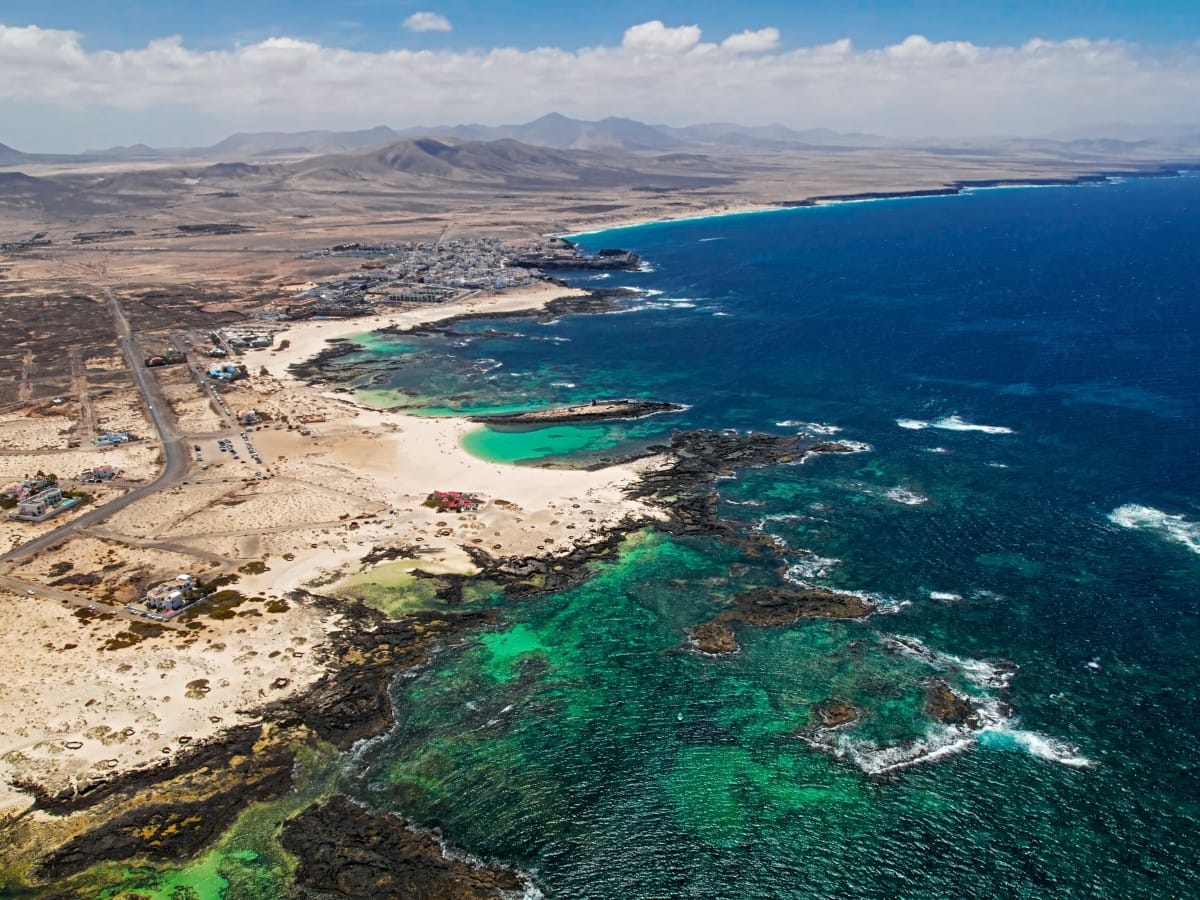
There are basically two (maybe three, maybe four) surf towns that lead the charge in Fuerteventura.
My hunch is that you’ll want to base yourself in one of these. They not only offer great access (sometimes walking access) to the best breaks on the island, but have fine surf schools and surf camps, plus some great hotels that are aimed squarely at traveling surfers.
Here’s a look at all three, in my personal order of preference…
El Cotillo
El Cotillo is the go-to place for most surf schools in Fuerteventura. It’s really a classic Canaries beach break: Hard work from September to March, easy-going from June to August.
A-frame waves with both lefts and rights over a white sand bottom when things pick up to a metre or so. Can’t really handle more than that and can also be crowded.
Gets pretty rough during winter because there are dominant N-NW swells that pull all the sandbanks to pieces. Better to wait for those to return – otherwise it’s rips and unpredictable sets.
The consistency and array of surf camps and whatnot mean that we rate this as one of the best surf destinations in Europe. It really is cracking.
>>We’ve also got a complete guide to surfing in El Cotillo and a guide to the most lovely beaches in El Cotillo
Corralejo
Corralejo is the main resort on the northeast side of the island, so expect more noise, more people, and more nightlife over here compared to El Cotillo.
It’s a pretty bumping place to be. There are great restaurants, some nice nightlife, and LOADS of surf hostels and things for the more budget-conscious.
The area you’ll surf here is known as the Grandes Playa – it’s a long run of beaches to the south of town that tend to get some of the better beginner waves around.
That said, Cotillo and the more punchy west coast is only 20 minutes’ drive away, so it’s easy to link up the shorelines no matter where you stay.
Where to stay? Dreamsea Surf Camp is one of the best surf stays in Fuerteventura, close to the main breaks of Corralejo town (Rocky Point is walkable!), and it’s dowright lush inside and out.
>>We’ve got a full guide to surfing in Corralejo right here
Majanicho
Majanicho is TINY, especially when comared to El Cotillo and Corralejo
I’m basically talking about one row of super rustic little cottages lined up along a volcanic reef on the north side of the island.
It’s sleepy, and it’s lovely for it.
There’s surf too. You can get a long right hander off the main harbor with good N swells. Or there’s spots that make up nearby El Hierro just a little west of the town. They can be really, really good, with hollow lefts at Izquierda and the barrels of The Bubble the stand out.
I mention Majanicho as a surf town because it’s a really awesome option for people who like to be out of civilization (meeee). There are a couple of simple cottages to let beside the main reef (which is surfable) and it’s just the best life – think morning sessions then chilling all day to the sound of the waves and wind.
Where to stay? This cabin! It’s got front-on views of the beach, cozy interiors, and a real desert island feel.
>>We’ve got a guide to surfing and staying in Majanicho
La Pared
La Pared is the gateway to just one or two beach breaks on the southwest coast. For me, it’s the perfect balance of chill and surf, with a fantastic break of its own.
The downside is that it’s quite far from the other surf towns listed here – you’ll need to drive an hour or more to get to the variety of breaks offered up on the north coast.
If you don’t mind that distance then the reward is cracking surf villas, hardly any crowds, and reliable beach breaks that suit all levels (depending on swell).
It’s also the place to base yourself to access the remote surf spot of Playa de Garcey, better known as Shipwreck Beach – an all-level gem (depending on sandbanks and swell) that takes like 1.5 hours to reach down dirttrack roads.
>>We’ve got a guide to La Pared
Surf spots in Fuerteventura
Variety is what makes Fuerteventura one of the top destinations in the whole Canary chain.
There are long beaches up north that have point breaks and reefs and beach breaks for beginners. There are barrels that will come alive in the midwinter. And there are hidden breaks down 4X4 tracks that only locals know about.
The island has three main surf regions, each linked to one of the surf towns mentioned above…
- The east (Corralejo) – In the east, Corralejo offers access to the Grandes Playa, which hosts about seven named breaks plus the island of Lobos, one of the best waves in the Canaries but a bit of a trick to get to.
- The west (El Cotillo) – There are beach breaks around El Cotillo that are good for all levels, but the town is also the gateway to the sparsely populated eastern shore of Fuerte, where there are some world-class waves like Spew Pits. My 2 cents: Stay here if in doubt, it’s the best all-round surf town on the isle.
- The north (Majanicho) – Some of the most challenging waves on the island hit the rocky north coast, but there are also some protected waves like the good storm backup spot in Majanicho bay. El Hierro is the main spot; a big, heavy, barreling reef break.
Here’s a closer look at each spot in each region…
The east (around Corralejo)

El Muelle
- Advanced
- Harbor wall
A tricky break that’s right in the middle of Corralejo town, El Muelle works just off the north side of the main harbor wall. It works when the tide peels back off the reef and the sets sit up a bit. They’ll get hollow and fast. It’s on shallow rock, so advanced only. Gets slabbly when its heavy.
Punta Elena
- Intermediate+
- Reef
Punta Elena is one of the main spots on the east coast since it’s within walking distance of the town center of Corralejo. It’s kinda like the outside section of Rocky Point (see below). Loves big N swells, when it can jack up some nice long, rippable (when big), trimmable (when small) shoulders going for 100 meters or more to the left and into the inside of the bay.
Rocky Point
- All levels
- Reef
Always popular since it’s located right in the town of Corralejo, Rocky Point is a great break when the biggest of low pressures skirt through the Atlantic in the winter. Swells will bend in and give nice long lines across the reef. And it is ALL reef – quite shallow at some points too. Good long lefts and shorter rights. There’s also an outside section that gets more size but generally suffers from wind.
El Burro
- All levels
- Rocky sand and reef
The farthest-from-town of the Grandes Playas around Corralejo, El Burro is a left-hander with a little right if you’re looking to practice.
The level really depends on the wind and the size of the swell. Big days mean you might need the experience to stop yourself from bailing over the shallower sections of reef.
But on smaller sets, it’s a decent place for progressing beginners and intermediates. Expect glassy, clean waves when the wind is down. Sadly, that rarely happens – strong easterly trades coming from Africa can really hack El Burro to pieces. Dodge the kitesurfers.
Playa del Morro
- Beginner
- Beach break
One of the main go-tos for local surf schools, Playa del Morro is a lovely looking beach break that can suit all levels. Mainly powered by wind swells that drift N-NE off Africa. That makes it a reliable choice in the summer months, without very many too-big days. Expect simple take offs with lefts and right and a lot of whitewash.
The biggest problem might be the crowds during the main seasons.
Los Lobos
- Expert
- Point break over shallow reef
The western side of the small island of Los Lobos is a surfing haven. There are waves here that roll for hundreds of metres off rocky points to create some of the longest rides in all of the Canaries.
They go right and can be chopped into several peaks when the summer easterly winds are pumping. When they aren’t, you might be blessed with a Los Lobos day – AKA Christmas has come early for regular-footed shortboarders who want to rip up walls of Atlantic water and drift in and out of barrels.
Expect localism. And remember you’ll need to get up early for the ferry (there are no hotels on Los Lobos!).
The west (around El Cotillo)

Spew Pits
- Expert
- Reef break
Don’t know what you’re doing? These one’s will pick you up and spew you out! Faster than you can say Las Lagunas, the waves here roll right and left over some pretty spiky reef.
They can be misleading because there are nice dashes of white sand framing the lot. But don’t be fooled: This is rock underfoot the whole journey. What’s more, with stronger swells, the local slab hunters will come out. It’s really only for the weathered local.
Piedra Playa (Playa del Castillo)
- Expert
- Beach break
The closest beach to the town of El Cotillo, located just below the cliffs to the south. As such, Piedra Playa is one of the most-surfed spots in the region.
The style of waves helps with that. You’ll be looking at A-frame wedges on all stages of the tide here. The place is notorious for closeouts on heavier swells, but it’s a cracking summer option, when small-wave surfing in the 3-5 foot zone makes it a mecca for beginners and fantastic for all the surf camps in El Cotillo (and there are now quite a few).
Esquinzo
- Intermediate+
- Reef
Esquinzo is one of the wildest surf spots on Fuerteventura’s northwest coast, a remote beach framed by dark cliffs and raw volcanic scenery. The wave here is a powerful left that breaks over a mix of sand and reef, producing long, fast walls when solid northwest swells roll in. It’s best on mid to high tide with light easterly winds, though it can get heavy and unpredictable at low.
Jarugo (Jarubio)
- Intermediate
- Reef
Jarugo (or Jarubio – I’ve heard it called both) is the place to go if you want to surf alone. I’ve done dawnies here and not seen another person rock up until I was coming out. It’s uber-remote, set along the west coast about 35 mins’ drive from El Cotillo – you need to pass through the little village of Tindaya.
The beach angles nicely a little northwest, which helps it suck up a bit more swell than other beaches that face straight west. It also means it holds better on larger days, and you can find some bombs here when it’s on.
Most of the time, it’s a great option when there’s more W in the swell, offering lefts and rights over a sand bottom. Some rips and it’s remote, so be careful.
The north (around Majanicho)

Punta Blanca
- Improvers+
- Reef
The north’s most accessible wave, Punta Blanca is a nice reef option that’s just a drive to the west of Majanicho, down that rumbling dirt road.
Yea, there are a few rips and the reef does have urchins that will be gagging to jab ya, but the wave is soft in a way that no other on the north coast is.
It has good swell protection from dead-on NW swells, so tends to be mellower than local spots. It’s an A-frame with shorter lefts that die out into a paddle channel. Reform waves closer to shore – but on shallower reef – offer something to practice on.
El Hierro
- Expert
- Volcanic reef
El Hierro is also known locally as The Bubble. You can see why. Ignore the shallow reef and you get a gliding A-frame wave that barrels beautifully to offer a capsule of water with zippy rides inside.
Fast. Demanding take offs. Lots of reef. Something like that is obviously reserved for experts.
However, when this one’s working – usually in the winter – there’s often a crowd of spectators to boot. Look for it smack bang in the middle of the north shore.
>>Check out our full guide to surfing in El Hierro right now
Bristol (Shooting Gallery)
- Advanced
- Reef
Bristol, often nicknamed the Shooting Gallery, is one of Corralejo’s most consistent reef breaks, firing through the winter months when north swells line up.
It’s mainly a left-hander that offers long, fast walls with rippable sections and the occasional barrel on bigger days. The take-off can be tricky over the shallow lava reef and it can be a salb with real power when the swells are large.
La Caleta
- Intermediate+
- Reef
A few mins’ drive east of Majanicho, where the headland dips away and opens up into yet another deserted bay, the reefs that fringe the Fuerte shoreline suck up nice N-angle swell to give some of the quickest left lines on this part of the island.
It’s a bit shifty out the back there but you can score nice long rides day after day. Beware: Reefs and rips.
When to surf in Fuerteventura?

The best time to surf in Fuerteventura is from October to March, when powerful Atlantic swells light up the island’s north and west coasts. This is peak season for consistent waves, offshore winds, and warm water that rarely dips below 19°C (that’s 66 F). Summer (May–August) brings smaller, friendlier surf – perfect for beginners around spots like El Cotillo and Corralejo.
Winter (October – March)
Calling all big-wave hunters hitting the Spew Pits and beyond – this is the season for you! Strong groundswells originating in the out-at-ocean Atlantic storms mean there’s usually plenty of wild waves to contend with down the west coast.
That filters through into the east, too, where you’ll find the Grandes Playas usually suited to intermediates.
It’s still warm in the Canarian winter (it’s rarely cold here), but you’ll want to bring along at least a 3/2. We’d also recommend booties, but only because you’re more likely to be surfing the reefs in the cooler months.
Wear: 2mm longsleeve or 3/2 at most
Summer (April – September)
The lighter summer swells bring smaller waves to the western beaches. There also some strong wind swells to be had on the east coast thanks to blustery currents coming in off Africa and the Atlantic.
On the whole, this is the top time for beginners to head to the sheltered bays of El Cotillo and the Grandes Playas, where the breaks will be much less hard work. That’s not to say there aren’t big days. There can be, especially towards the shoulder season months of September and early on in April.
Wear: 2mm longsleeve or 3/2 at most
Surf camps in Fuerteventura

Perhaps the best way to sort a surf trip to Fuerte without the hassle of booking flights and car rentals all on your own is to pick a surf camp.
There’s over 60 on offer on the island, but some aren’t that well rated. The ones below, however, are usually solid, solid choices…
- Surf & Yoga Fueteventura – These guys hit the perfect balance between social surf camp and proper, hands-on teaching. You’ll also stay in a really nice surf villa near some of the prettiest beaches on the north side of the island.
- Surferscape Fuerteventura – This is a pretty slick camp option because it’s pretty dang luxury on top of being great for surfing. Based in Lajares, it’s prime for hitting any and all north coast spots. They have a pool and a very stylish surf villa with its own yoga shala. Totally worth the extra $$.
- Line Up Surf Camp – Line Up has become one of the top-10 booked surf camps in the whole of Europe by doing one thing dead right: Offering great surf teaching at an affordable price. $400 or so is all it costs for a stay here, which includes five lessons across 8 days and a stay at thier lovely surf villa-come-hostel.
>>For more inspiration, check our guide to the best surf camps in Fuerteventura
The best hotels (for surfers) in Fuerteventura

One of the best things about surfing in Fuerteventura is the sheer wealth of accommodation options that are on the menu.
Before this island was even on the radar for surfers, it was a popular holidaying destination. That means you’ve got all sorts, from family-sized Fuerteventura surf villas to chilled hostels close to the breaks.
Some, for us, really do stand out from the crowd, though…
- El Hotelito del Cotillo – We’ve already mentioned this one. A charming boutique spot in El Cotillo that’s for adult’s only. Bit of a Moroccan vibe with lovely outdoor spaces where you can chill, read, relax.
- Surfers Retreat – The bargain option, with its uber-cheap dorms, living room, shared kitchen, and top location in the heart of Corralejo (also walking access to breaks like Rocky Point). You’ll meet fellow surfers easy.
For something more budget friendly, check out our guide to the top surf hostels in Fuerteventura.
Surf lessons in Fuerteventura

With locations like Cotillo and Coralejo up its sleeve, it’s hardly a surprise that Fuerte is home to a whole menu of great surf schools.
In our opinion, they are among the most accessible in Europe, mainly becuase they are well used to offering lessons to families with little ones, complete beginners, and – frankly – tourists that don’t know the first thing about surfing.
We say that in a good way, because they know what novices really are after and make it fun.
he best ones on the island are:
- Fuerteventura: Learn to Surf Lesson with Canary Surf Academy – Up there with the best beginner packages of all is this all-round lesson package that can be tailored to just about whatever you want from your tuition. You can pick private or shared lessons. You can do 4 hours or three days. And there’s pick up, gear, and transport included. It’s a great option with rates starting at around just $55 per person.
- Learn to surf on the white beaches in Fuerteventura’s south with OTRO MODO Surfschool – The more adventurous option here is to choose this surfari that takes you to the lesser-known southern beaches. A pickup can be included from your resort but you have to let them know in advance. They offer excellent quality Ocean&Earth boards and gear and you’ll be in safe hands with a real local surf expert.
Get insured. [ad]
I use SafetyWing. They’ve got two plans: Essential and Complete. Surfing is included as standard in both.
Things I like:
- Buy while you’re abroad. No penalties if you’re already traveling.
- Flexible packages. You can either get it as a subscription, so it rolls on until you cancel, or pay for certain dates.
- Surfing is included as standard in the Essential plan. No add-ons needed.
Surf shops in Fuerteventura
Searching for fins? Need a rash vest? Below we list some of the top-rated and most trusted surf shops on the island of Fuerteventura.
- Paradise Surf – One of the original surf shops on the island is Paradise Surf. Find it – actually them (there are two locations) – nestled into the backstreets of lively Corralejo. There, it’s got stacks of goodies. Huge racks of boards both long and short adorn the back walls. There are rails and rails of surf gear from well-known brand names. There’s also one huge collection of rental boards on offer.
- Riders Surf’N Bike – A mix-and-match store that serves cyclists just as much as wave riders, Riders Surf’N Bike sits on the southern end of El Cotillo. Inside are a few racks of mainly shortboards, but you can also find the basics – wax, rash vests, sun cream. Look out for the resident golden retriever.
Travel essentials for Fuerteventura
Where is Fuerteventura?
Fuerteventura is the second largest of the Canary Islands. Just a smidgen to the south of Lanzarote, it gazes eastwards to Africa and westwards to the rest of the Spanish islands.
You can arrive straight by plane into the capital of Puerto del Rosario, which is midway down the east coast. Or, you can get a ferry across the strait from Playa Blanca. More on that below…
How to get to Fuerteventura?
Fuerteventura has its own airport: El Matorral Airport. Find it right in the middle of the east coastline, around 30-35 minutes’ drive south of the main surf resorts on the northern shores.
Regular flights serve the destination, with plenty of low-cost carriers offering links from the UK. There tend to be more departures in the high seasons, which are around the midsummer and at Christmas.
We usually use Kiwi to search for flights before any other engine – we like the interface and tickets are continually pretty cheap there.
Do I need a car to surf in Fuerteventura?

There’s no doubt about it: The very best way to get around on your Fuerteventura surf trip is by car.
Rental companies are used to travellers bringing their boards in tow but be sure to contact them ahead of time to let them know. You might need to pay a little extra for a roof rack and a larger hire.
In our experience, car hires generally on the Canaries and in Spain are cheap – around €300 for a full month isn’t unheard of!
I’ve been using DiscoverCars for my hires in Fuerte and Europe generally in the last few years – I just find they have some of the cheapest rates around.
Now, you don’t HAVE to get a car. We just think it’s just it’s the best way to go about things. There are some people that absaloutely will not need thier own wheels, such as people enrolled on surf-camp packages, or those staying by the beach in El Cotillo who are happy with surfing just that one break for the duration.
Things to do (when you’re not surfing) in Fuerteventura

Fuerteventura is a fun and enthralling place to be, whether you’ve got your sights set on the waves or not. A Mars-like landscape of volcanic cones meets sweeping bays and beaches topped by geological protrusions in this land. Oh, and there are some fun-filled resort towns for partying and chilling to boot.
Sotavento
Prepare to be stunned as you drop down on the eastern stretch of shoreline that’s known as Sotavento. This really is a stunning length of beachfront.
Wild and gleaming white, it runs for several kilometres, past sandbanks and shallow inlets that turn the Atlantic Ocean a pale shade of Caribbean turquoise. Some areas here are fully nudist, so watch where you tread if you’re not going au natural.
Lobos Island
Lobos isn’t only famed for its long, peeling right-handers. It’s also a haven for birdwatchers and wildlife enthusiasts. Rare creatures and plants meet on the salt-washed volcanic fields that roll in from the coast. There are some awesome hiking paths to tackle, along with lookout points and pretty little lagoons for swimming and snorkelling.
Betancuria
Charm oozes from the cobbled streets and white-painted churches of Betancuria. A small village on the western slopes of the island, it’s steeped in local history. In fact, the place was once the capital of the whole Kingdom of the Canary Islands.
It’s got the first convent on the isle and comes wrapped in tales of Norman invaders. Expect to find lovely craft workshops making local cloth – a favourite Canarian souvenir.
Where to eat in Fuerteventura?
- Bamba Rooftop Fuerteventura – My fav sunset spot for post-surf beers and plates of chippos.
- Pika Surf – Stacked burgers, chilled beer, and a smile with service – what more could you want? This surfer’s joint in the heart of El Cotillo is the place to be for lunch and dinner. The menu is broad and varied, with a little something for everyone, provided you don’t mind casual eating. Prices are reasonable.
- L’Oca Blanca – Sleek, Italian cooking in the heart of Corralejo. Carpaccio plates with zesty dressings meet seafood dishes and handmade ravioli to create a menu that really plays to the essence of Latin cooking. The setting is also romantic, making it the perfect spot for an evening on a Fuerteventura surf honeymoon!
- H2O Juice Bar & Vegan Cafè – Make a pitstop at this lovely little Vegan eatery in the main resort to get your healthy breakfast/brunch before/after hitting the waves. They’ve got a tight-knit little venue with a menu that reads poke bowls, meat-free burgers, fresh veg soups and more.
We might use affiliate links in this post. Basically, you click em’ and we get a little something from your booking or purchase. They help us keep offering more and more in-depth surf guides to awesome places all around the globe. So, thanks for that!
